Peptides from bench to biohack
A dozen amino acids in the right order can tell a cell to build a blood vessel. That is the appeal. What the approved ones actually do, what the research ones have not shown yet, and where the line between them falls.
Last updated
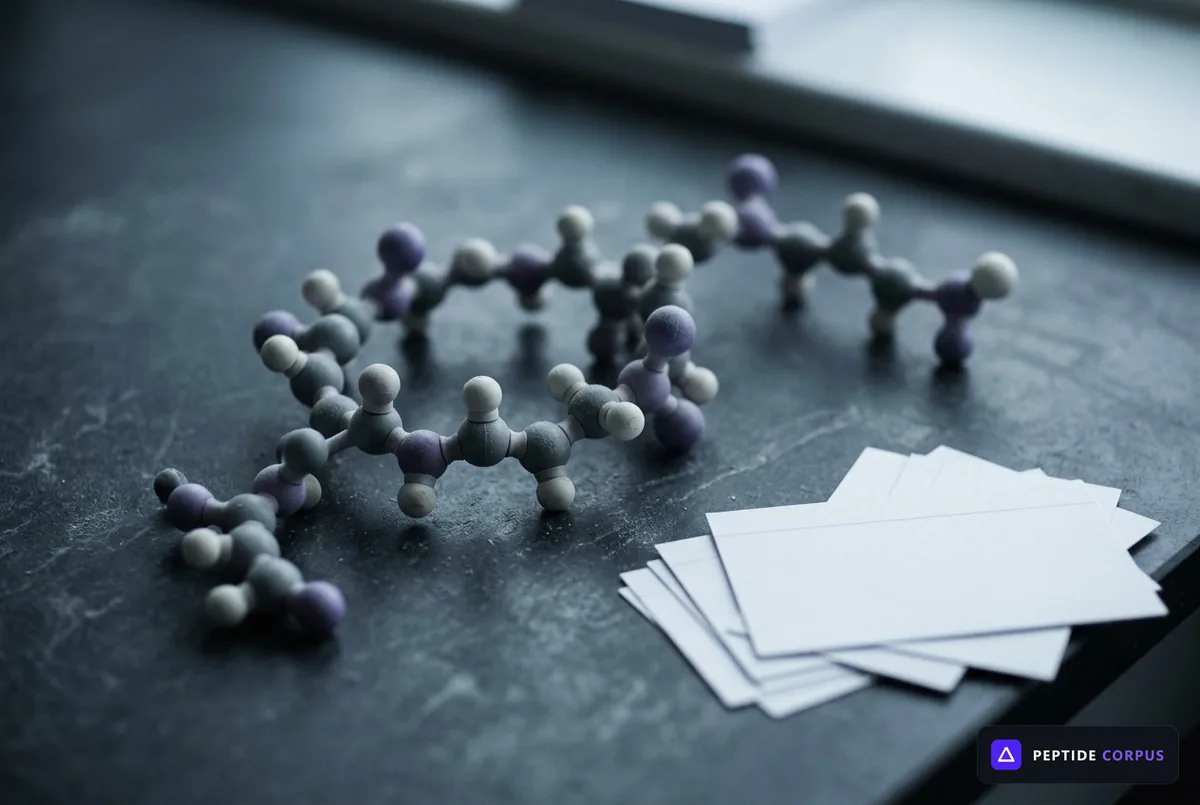
The divide that matters first
Start with the thing that makes peptides worth the attention. A chain of a few dozen amino acids walks up to a receptor the body already uses and tells the cell what to do next. No brute force, no foreign machinery — the message arrives in a language the cell has been speaking since before you were born. That is a genuinely elegant piece of biology, and it is why this field moves as fast as it does.
Now the boundary, which is messier than anyone admits. Two definitions of "short" are in circulation and they disagree. The textbook convention is 2 to 50 residues. US regulation draws its line at 40 — above that a molecule is a protein and takes a different approval route entirely. So between 41 and 50 residues you have a compound that is a peptide by convention and a protein by law.
Either definition covers a drug with millions of patient-years behind it and a vial sold with "not for human consumption" printed on the side. The chemistry does not tell those two apart. The evidence does, and that is the line this entire site is built along.
Approved therapeutics
Carry phase 3 trial data, an approved label, and manufacture under cGMP. Semaglutide and tirzepatide are the widely prescribed examples.
- Indications and dosing are on a public label
- Identity and purity are a regulatory requirement
- Prescription-only, with a traceable supply chain
Research compounds
Sold explicitly as not for human consumption. BPC-157 and CJC-1295 sit here. Much of the preclinical work is real; what is absent is the human record.
- No approved label, so no established dose
- Purity varies between sellers and between batches
- The uncertainty is as much supply chain as pharmacology
Three ways a peptide acts
This is the part worth getting excited about. A peptide does not force a system open. It knocks on a receptor the body already uses, and everything downstream is the body's own cascade — which is how a molecule this small moves something as large as appetite or blood supply. Three patterns cover most of what is on file.
-
Receptor agonism
GLP-1 analogues bind receptors in the gut, pancreas and hypothalamus at once, slowing gastric emptying and altering appetite signalling. Attaching a fatty-acid chain lets the molecule ride serum albumin. The semaglutide label names that binding as the principal mechanism behind its half-life of about a week.
-
Hormone secretagogues
Rather than supplying growth hormone from outside, these act on GHRH or ghrelin pathways so the pituitary releases its own pulse. CJC-1295 with ipamorelin is the pairing most often described — and the corpus holds CJC-1295 as two separate records, with and without the DAC modification. The DAC version's half-life was measured at 5.8 to 8.1 days in healthy adults. The version without it has no comparable human figure on file.
-
Tissue repair and angiogenesis
Repair-associated peptides upregulate vascular endothelial growth factor and modulate inflammatory cytokines, which in animal models speeds cell migration and matrix remodelling.
The peptide matrix
Five families, and the sweep of them is why people fall down this particular rabbit hole: appetite, growth, repair, cognition, mitochondria. Read the last column strictly, though. What a row is studied for describes the approved compounds in it, and says nothing about the research-grade ones sitting beside them.
Families on file
5 categories · 13 compounds| Category | Key compounds | Mechanism / target | Studied for |
|---|---|---|---|
| Metabolic | Semaglutide, Tirzepatide, Retatrutide | GLP-1 / GIP / glucagon receptor agonism | Weight reduction and glycaemic control, in phase 3 trials |
| Growth secretagogues | CJC-1295 DAC, CJC-1295 no-DAC, Ipamorelin, Sermorelin | Pituitary GHRH / ghrelin receptor activation | Endogenous GH and IGF-1 pulse, body composition |
| Healing and recovery | BPC-157, TB-500 | Fibroblast activation, actin binding, angiogenesis | Tendon and ligament repair — animal models |
| Cognitive | Semax, Selank | ACTH fragments, BDNF modulation, nasal CNS access | Focus and anxiolysis, largely outside Western trials |
| Mitochondrial and longevity | SS-31, Epitalon | Cardiolipin stabilisation, telomerase | Cellular energy and oxidative stress |
Where the evidence comes from
Here is the tool that makes everything above readable. Every record on this site is graded on one ladder, strongest evidence at the top, and the rubric is published so you can argue with any grade we hand out. A rung is a statement about the best study on file — not a verdict on whether a compound works. Plenty of genuinely promising things sit low down because nobody has run the trial yet.
Evidence ladder
Strongest to most exploratory- 01
72 compounds
Human RCT
Randomised controlled trial in humans.
- 02
46 compounds
Human observational
Cohort, case-control, cross-sectional or registry data in humans.
- 03
2 compounds
Human case series
Clinician-documented individual human cases, uncontrolled.
- 04
52 compounds
Animal in vivo
Whole-animal studies.
- 05
8 compounds
In vitro
Cell culture, tissue, or cell-free systems.
- 06
0 compounds
Theoretical
Mechanistic reasoning, with no direct measurement for this claim.
- 07
3 compounds
Computational
In silico only — docking, structure prediction, QSAR, machine learning.
A rung is the strongest study on file, not a verdict. 6 of the 7 rungs are the top of some compound's record, and 5 of 188 records carry no tier at all — that is the finding, not a gap in ours. The rubric is published, so any grade here can be audited.
Handling conventions
The practical layer, and it is more interesting than it sounds: most of what goes wrong with a peptide happens between the vial and the syringe rather than in the pharmacology. These are the conventions the field works to and what the diluent record supports. They describe practice. They are not instructions, and nothing here recommends that anyone use anything.

Reconstitution
Lyophilised powder is mixed with a diluent, usually bacteriostatic water, before it can be drawn. Mass divided by diluent gives concentration; dose divided by concentration gives volume.
Beyond-use date
A multi-dose vial is dated at first puncture and discarded 28 days later, unless the manufacturer states another date. Bacteriostatic water qualifies because its benzyl alcohol is a preservative; sterile water and plain saline carry none and get no such window. The 28 days is a rule about the vial, not a storage temperature.
Certificates of analysis
A COA states one batch's test results, issued by whoever ran them — usually the manufacturer's own quality unit, not an independent lab. It covers that batch and nothing else.
Baseline measurement
Metabolic panel, fasting glucose and insulin, lipids, thyroid and IGF-1 are the markers usually recorded before and during use, because they are what any change would show up in.
Glossary
Every term used above, defined the way this site uses it. No word should be doing load-bearing work in an article you cannot check.
- Acylation
- Attaching a fatty-acid chain so the molecule binds serum albumin, which slows clearance and extends half-life.
- Angiogenesis
- Formation of new blood vessels.
- Beyond-use date
- The date a multi-dose vial is discarded after first puncture — 28 days by convention, unless the manufacturer states another.
- Certificate of analysis
- One batch's test results, issued by whoever ran them — usually the manufacturer, not an independent lab.
- Endogenous
- Produced by the body itself.
- Exogenous
- Introduced from outside the body.
- Growth hormone secretagogue
- A compound that prompts the pituitary to release its own growth hormone rather than supplying it.
- Half-life
- The time for the concentration in the body to fall by half.
- Lyophilised
- Freeze-dried to powder, the form peptides are stored in before reconstitution.
- Reconstitution
- Mixing lyophilised powder with a diluent to make a solution.
- Residue
- A single amino acid unit within a chain.
- Stacking
- Combining two or more peptides in one protocol.
Sources and evidence
Sources and evidence
14 sourcesKaprive JF, Krishnamurthy K. Biochemistry, Peptide. StatPearls, updated 28 August 2023Reference text
How this source supports the article
The 2-to-50 convention in the opening paragraph, quoted from this entry: a peptide is "a short string of 2 to 50 amino acids, formed by a condensation reaction".
Limitations
A teaching reference rather than a primary study, and the range is a convention, not a measured boundary. The entry draws no line at all between peptide and protein — that line comes from the regulation below.
21 CFR 600.3(h)(6) — definition of "protein"Regulation
How this source supports the article
The 40-residue figure. FDA's definition is "any alpha amino acid polymer with a specific, defined sequence that is greater than 40 amino acids in size".
Limitations
A United States regulatory boundary deciding which approval route a molecule takes, not a chemical one. It overlaps the 2-to-50 convention between 41 and 50 residues, which is why the article names both rather than picking one.
Lau J, Bloch P, Schäffer L, et al. Discovery of the once-weekly GLP-1 analogue semaglutide. J Med Chem 2015;58(18):7370–80Peer-reviewed
How this source supports the article
The acylation mechanism. The fatty-acid moiety and its linking chemistry were the design features chosen to raise albumin affinity and prolong exposure.
Limitations
Every half-life in this paper is mini-pig, not human: 46.1 hours after intravenous dosing. The human figure comes from the label below, and the two must not be read as one number.
OZEMPIC (semaglutide) injection — US prescribing information, section 12.3FDA label
How this source supports the article
The "about a week". The label states an elimination half-life of approximately 1 week, and names albumin binding as "the principal mechanism of protraction".
Limitations
It describes one molecule. Other acylated peptides bind albumin to different degrees — liraglutide is acylated too and is dosed daily — so a week is semaglutide's number, not acylation's.
Coskun T, Sloop KW, Loghin C, et al. LY3298176, a novel dual GIP and GLP-1 receptor agonist. Mol Metab 2018;18:3–14Peer-reviewed
How this source supports the article
The GIP half of the metabolic row's mechanism cell. Tirzepatide is characterised here as a dual agonist at the GIP and GLP-1 receptors.
Limitations
Written by the developer, and it runs from discovery to phase 2 proof of concept — not to the phase 3 outcomes the row's "studied for" cell refers to.
Coskun T, Urva S, Roell WC, et al. LY3437943, a novel triple glucagon, GIP, and GLP-1 receptor agonist. Cell Metab 2022;34(9):1234–1247.e9Peer-reviewed
How this source supports the article
The glucagon-receptor arm of the same cell. Retatrutide is characterised here as a triple agonist, with balanced GCGR and GLP-1R activity and more GIPR activity.
Limitations
Obese mice plus a phase 1 single-ascending-dose study, and developer-authored. It establishes the mechanism, not the outcome.
Raun K, Hansen BS, Johansen NL, et al. Ipamorelin, the first selective growth hormone secretagogue. Eur J Endocrinol 1998;139(5):552–61Peer-reviewed
How this source supports the article
The secretagogue mechanism. Antagonist profiling showed ipamorelin releases growth hormone through a GHRP-like receptor, so the pituitary supplies its own pulse.
Limitations
Rat pituitary cells, anaesthetised rats and conscious swine. There is no human data in this paper, and the corpus grades ipamorelin on that basis.
Teichman SL, Neale A, Lawrence B, et al. Prolonged stimulation of GH and IGF-I secretion by CJC-1295. J Clin Endocrinol Metab 2006;91(3):799–805Peer-reviewed
How this source supports the article
The 5.8-to-8.1-day half-life, in healthy adults, and the GHRH-analogue mechanism behind the growth secretagogue row.
Limitations
This is CJC-1295 with DAC. The figure does not transfer to the no-DAC product sold under the same name, which is exactly why the corpus holds the two as separate records.
Seiwerth S, Brcic L, Vuletic LB, et al. BPC 157 and blood vessels. Curr Pharm Des 2014;20(7):1121–5Peer-reviewed
How this source supports the article
The VEGF and angiogenesis mechanism, both in the healing row and in "Three ways a peptide acts".
Limitations
A review, animal throughout, by the Zagreb group that has produced most of the BPC-157 literature. No human trial supports this row, and the record says so.
Hannappel E. beta-Thymosins. Ann N Y Acad Sci 2007;1112:21–37Peer-reviewed
How this source supports the article
The actin-binding half of the healing row. Thymosin beta-4, the parent of TB-500, sequesters G-actin and is the main intracellular G-actin-sequestering peptide in most vertebrate cells.
Limitations
The review is explicit that very little is known about the mechanisms behind the effects attributed to extracellular beta-thymosins, which is the part a repair claim actually rests on.
Dolotov OV, Karpenko EA, Inozemtseva LS, et al. Semax, an analog of ACTH(4–10), regulates BDNF and trkB expression in the rat hippocampus. Brain Res 2006;1117(1):54–60Peer-reviewed
How this source supports the article
All three items in the cognitive row: an ACTH(4–10) analogue, BDNF modulation, and the intranasal route.
Limitations
Rats, a single dose, and a small effect — a 1.4-fold rise in hippocampal BDNF protein. The row's "largely outside Western trials" describes the wider literature, not this paper.
Birk AV, Liu S, Soong Y, et al. The mitochondrial-targeted compound SS-31 re-energizes ischemic mitochondria by interacting with cardiolipin. J Am Soc Nephrol 2013;24(8):1250–61Peer-reviewed
How this source supports the article
Cardiolipin stabilisation in the longevity row. SS-31 binds cardiolipin on the inner mitochondrial membrane and protects cristae.
Limitations
A rat renal ischaemia-reperfusion model. It shows a mechanism in injured tissue, not an effect on ageing in a healthy person.
Khavinson VKh, Bondarev IE, Butyugov AA. Epithalon peptide induces telomerase activity and telomere elongation in human somatic cells. Bull Exp Biol Med 2003;135(6):590–2Peer-reviewed
How this source supports the article
The telomerase half of the longevity row.
Limitations
The weakest source on this page, and named as such. In vitro, in human fetal fibroblast culture, from the group that developed the peptide, and not independently replicated.
CDC, Preventing Unsafe Injection PracticesPublic health guidance
How this source supports the article
The 28-day window: "Once a multi-dose vial is opened (e.g., needle-punctured) the vial should be dated and discarded within 28 days unless the manufacturer states another date for that opened vial."
Limitations
A rule about multi-dose vials in general, not about bacteriostatic water specifically, and it sets no storage temperature. Refrigerating a reconstituted solution is a separate convention with a separate basis. Three bacteriostatic water labels on DailyMed were checked: none of them states 28 days.