188 peptide and GLP-1 records, 183 graded

From clinical proof to smart sourcing: everything peptides.

Stop guessing on half-lives, side effects and protocols. Search evidence graded against a published rubric, reconstitute and check what can share a vial, and let Corbin compare vendors on price and published certificates.

/peptides/bpc-157

BPC-157

Also called BPC-157 (GI) · 2 aliases resolved

human observational
  • Strongest runghuman observational
  • Graded ona registered clinical study
  • Citations on file3
  • Fields not on file3

not on file SMILES string, CAS registry number, amino-acid sequence — each with the reason it is empty.

Why this grade?

A claim sits on the highest rung holding at least one qualifying record. Never an average, never a score.

  1. human_rct 0
  2. human_observational 1 ← grades here
  3. human_case_series 0
  4. animal_in_vivo 0

One citation names a registered clinical study, so the record grades there. The other 2 could not be placed and were left ungraded rather than guessed at — a wrong rung is a false statement on every page that renders it.

No gate, no account, nothing to install

Peptide reconstitution calculator

Vial strength, diluent volume and the dose you want. It returns the concentration and the exact number of units to draw on an insulin syringe. Worked example below: 5 mg in 2 mL is 2.5 mg/mL, so a 250 mcg dose is 0.1 mL — 10 units on a U-100 barrel.

Reconstitution calculator Preview — the full tool has four modes

10 unitsto draw on a U-100 syringe

Concentration
2.5 mg/mL
Volume to draw
0.1 mL
Doses in the vial
20

Beyond-use date is 28 days from first puncture, refrigerated.

Open the full calculator

How the arithmetic works

  1. Concentration. Vial contents in mg divided by the diluent volume in mL. 5 mg in 2 mL gives 2.5 mg/mL.
  2. Volume. Your dose divided by that concentration, which is the amount of liquid to draw. 250 mcg at 2.5 mg/mL is 0.1 mL.
  3. Units. Volume in mL multiplied by the syringe factor — 100 for a U-100 barrel, 50 for U-50, 40 for U-40. 0.1 mL is 10 units.

Reconstituted vials carry a 28-day beyond-use date from first puncture when kept refrigerated. Per-compound reconstitution records, where they exist, are on each compound page — for example BPC-157, semaglutide and tirzepatide. Where no stability record exists, the record says so rather than estimating.

Need target concentration, pull-to-units or a pre-mixed pen? Those are the other three modes in the full reconstitution calculator, alongside the beyond-use date calculator.

Free, no account

Peptide stack checker

Assemble the compounds you are running and hand the list to the full checker. It reads every pair in the stack, and says so plainly where nothing in the record covers one.

Stack checker Preview — build the list, the full tool reads the pairs
  • BPC-157
  • TB-500
  • CJC-1295 no-DAC
  • Ipamorelin
  • MK-677

Up to 10 compounds. Nothing is saved and nothing here is a recommendation.

Check this stack

How a pair is read

  1. A curated pair first. Where that exact combination carries a record of its own, it answers and nothing below it is consulted.
  2. Then the class rule. Every record carries a class — GLP-1-receptor agonist, GHRH analog, ghrelin mimetic. A pair of classes can carry a rule of its own, a class paired with itself included.
  3. Then the two records’ own mechanisms. Where both name one, the verdict is derived from those rather than guessed at.
  4. Then nothing. No curated pair, no class rule and no mechanism on either record returns nothing on record.

What “nothing on record” means

It is a statement about our records, not about safety. An unread pair is never rendered as compatible: silence is reported as silence, because a checker that quietly upgrades an absence into a verdict is worse than no checker.

Same body is not the same vial — whether two compounds can share a draw is the syringe planner. The full stack checker also counts injection burden from the dosing on file and reads FDA-label contraindications where they exist, and the same list carries into the protocol builder and the cost calculator.

Three jobs, in the order you meet them

What the app actually does

Not a grid of twelve icons. What you read, what you run, and what the record gives you back.

Know what you are taking

188 records. 1,212 aliases resolved to 203 canonical terms, an evidence tier on the 183 records that earned one, and the gaps declared rather than hidden.

  • Browse every record, and keep the ones you are running
  • The tools — reconstitution, beyond-use, vial check, dose scaling, stack checker, protocol builder, cost calculator
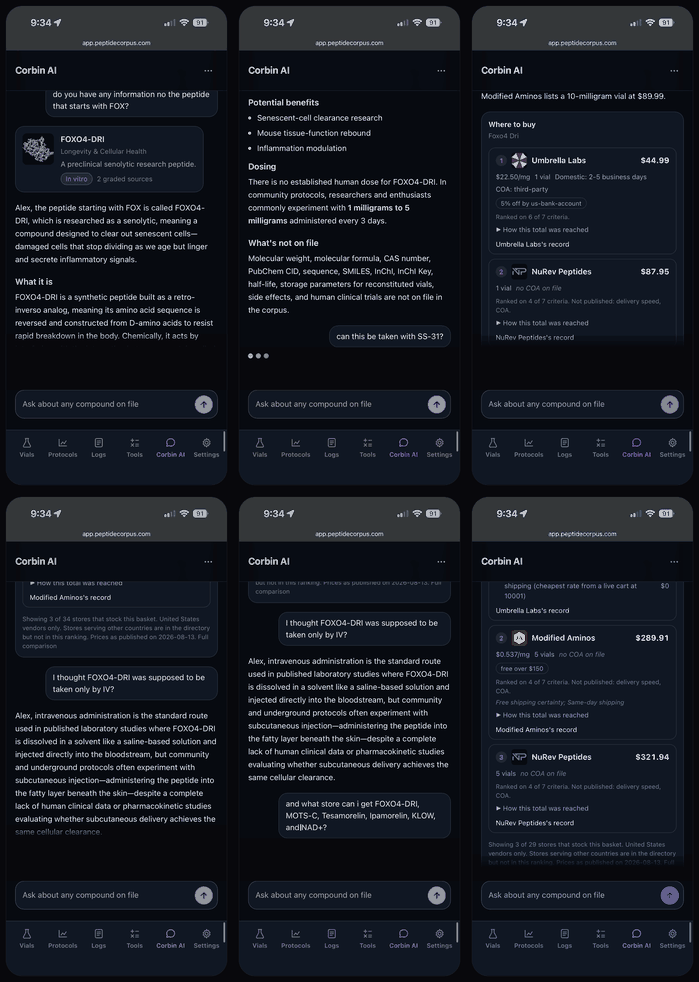
  • Corbin AI: reads the corpus, writes to your record, and prices a basket

"Cibinetide", "Pralmorelin" and "incretin axis" each resolve to their canonical entry.
Run the protocol

The reconstitution calculator and the beyond-use clock work now, signed out. In an account the mixed vial is saved and the 28-day clock starts from first puncture. Ask Corbin to work one out and it answers with the same calculator, live, and a button that saves the result as a vial.

  • Save a vial with the date it was mixed, and watch its beyond-use clock
  • Log doses, weight and the journal, on one timeline

mass ÷ diluent = concentration. dose ÷ concentration = volume. × the syringe factor = units on the barrel.

See whether it is working

Your own record, read back to you — against the doses that were running at the time, which is the part a tracker on its own cannot do.

  • Track bloodwork: upload a panel, and read it over time
  • Export a clinician report from your own history
  • A wellness report, built from your profile and what you logged

Trackers hold outcomes or doses. One timeline is what lets a change be read against what was running that week.

Corbin AI

Ask it anything on file, and it shows the working

Our own model, reading our own corpus. Every answer opens with the compound it found, the rung that compound grades on and how many sources are behind it — so the tier is on screen before the prose is, and you can go and read them.

  • It answers from the record, and says so when the record is empty.
  • Ask it to work out a reconstitution and it runs the same calculator this page does, then offers to save the result as a vial.
  • Ten messages a month on the free tier, thirty on Pro, unmetered on Ultra.

Start Free App No card.

A recording of Corbin AI on a phone. Asked about the peptide starting with FOX, it answers with a card for FOXO4-DRI showing its domain, an in vitro evidence chip and two graded sources, then explains what the compound is in prose beneath.

Free to start, no card

Your vials, your doses, your record

Mix a vial, run a protocol, log where every dose went. It is the part the reference sites do not have.

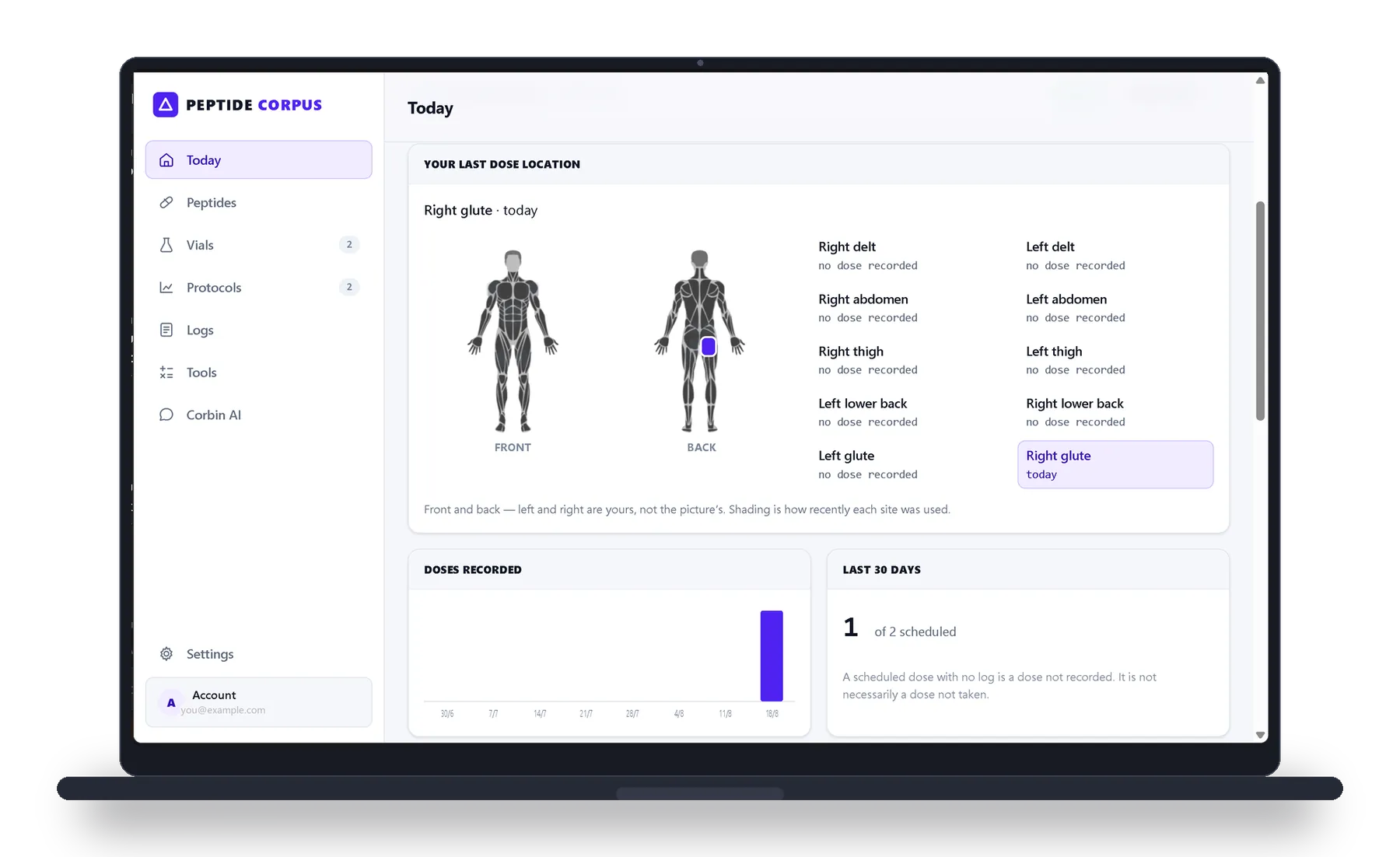
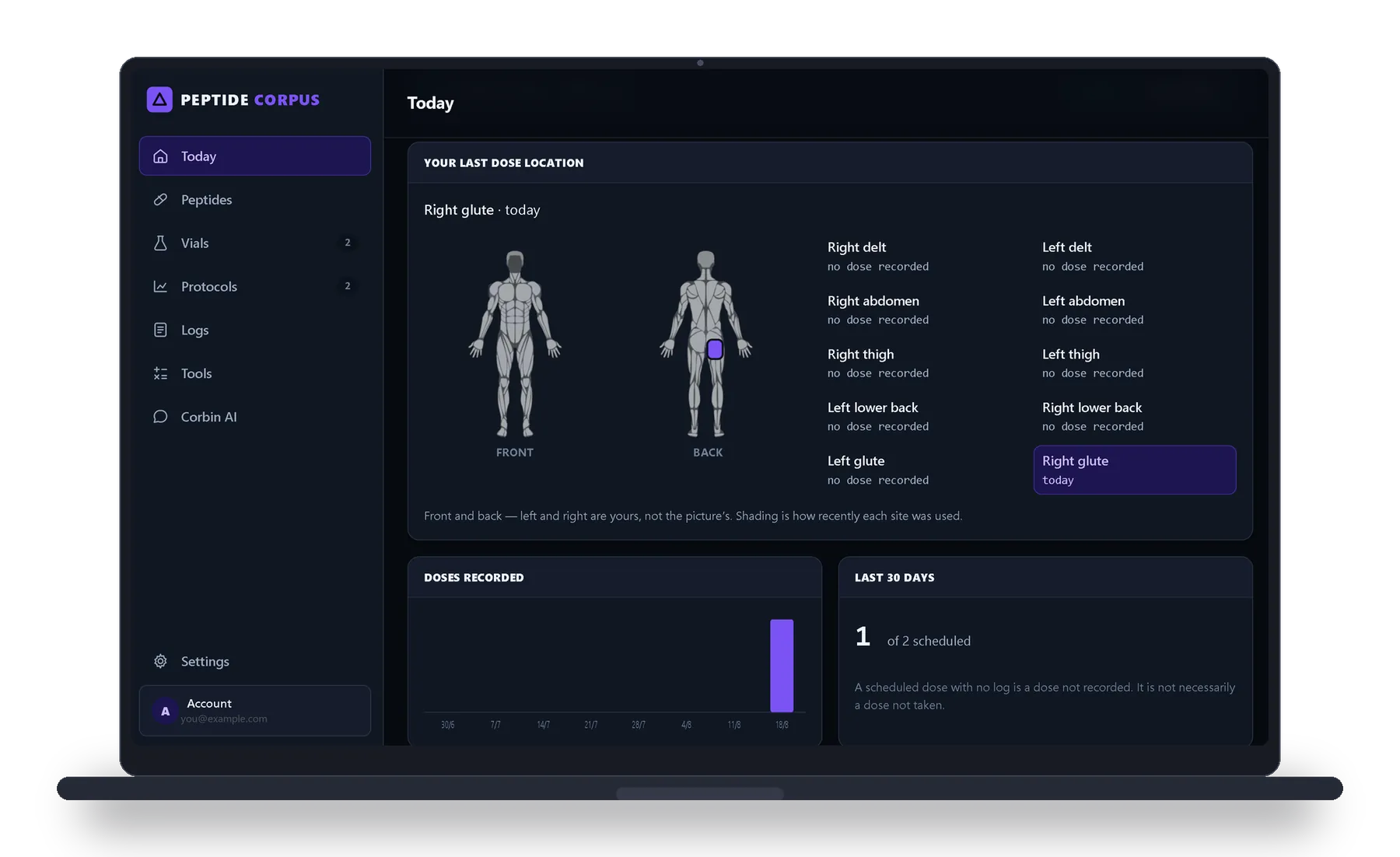
The app open on the Today screen, showing front and back body diagrams with the most recent injection site marked, and a list of ten sites with when each was last used. The app open on the Today screen, showing front and back body diagrams with the most recent injection site marked, and a list of ten sites with when each was last used.
Every dose, and where it wentTen injection sites, shaded by how recently you used each one. The rotation is kept for you, so you are not remembering it in the shower.
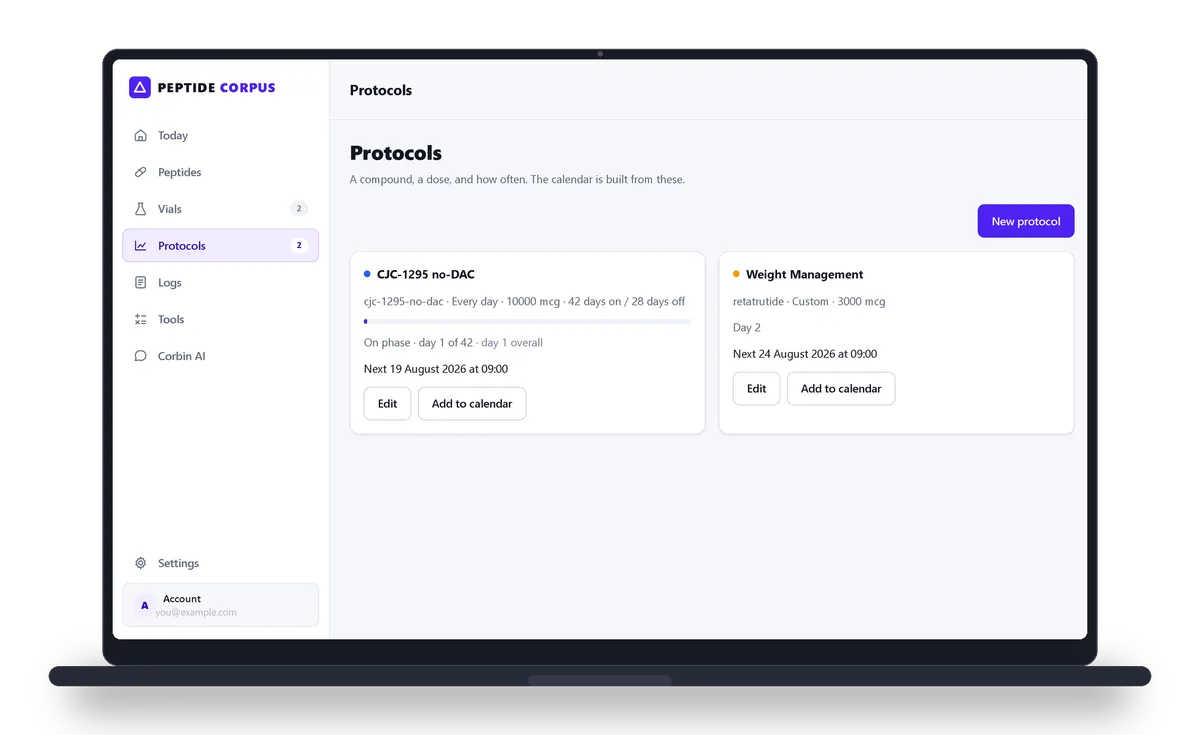
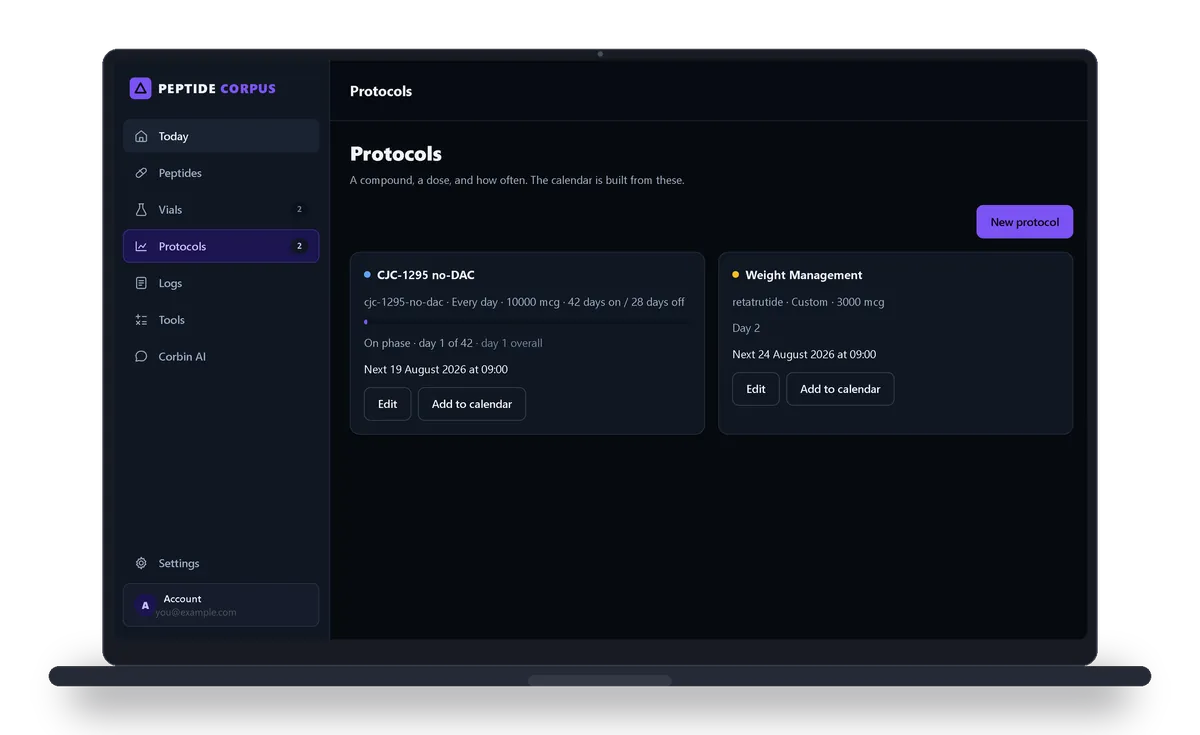
The Protocols screen with two protocols, each showing its compound, dose, schedule, the day it has reached and its next dose date, with an add-to-calendar button. The Protocols screen with two protocols, each showing its compound, dose, schedule, the day it has reached and its next dose date, with an add-to-calendar button.
A compound, a dose, how oftenSet it once and the calendar fills itself. Every protocol shows the day it has reached and when the next dose is due.
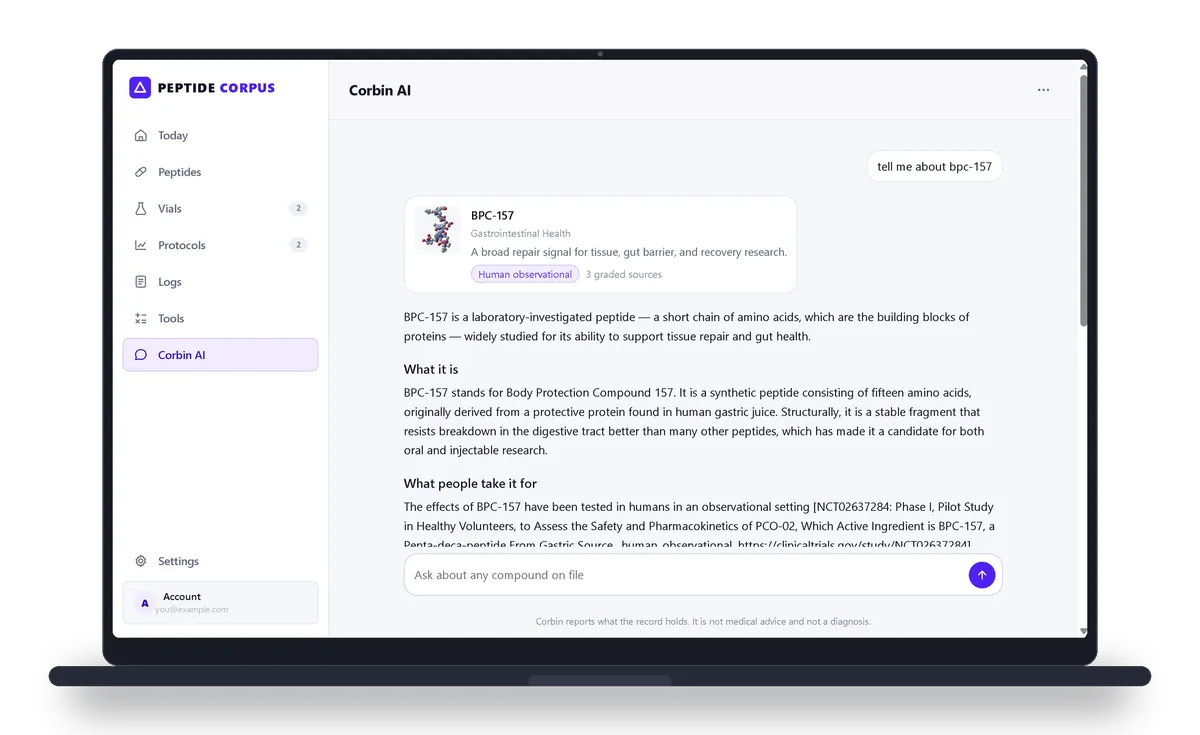
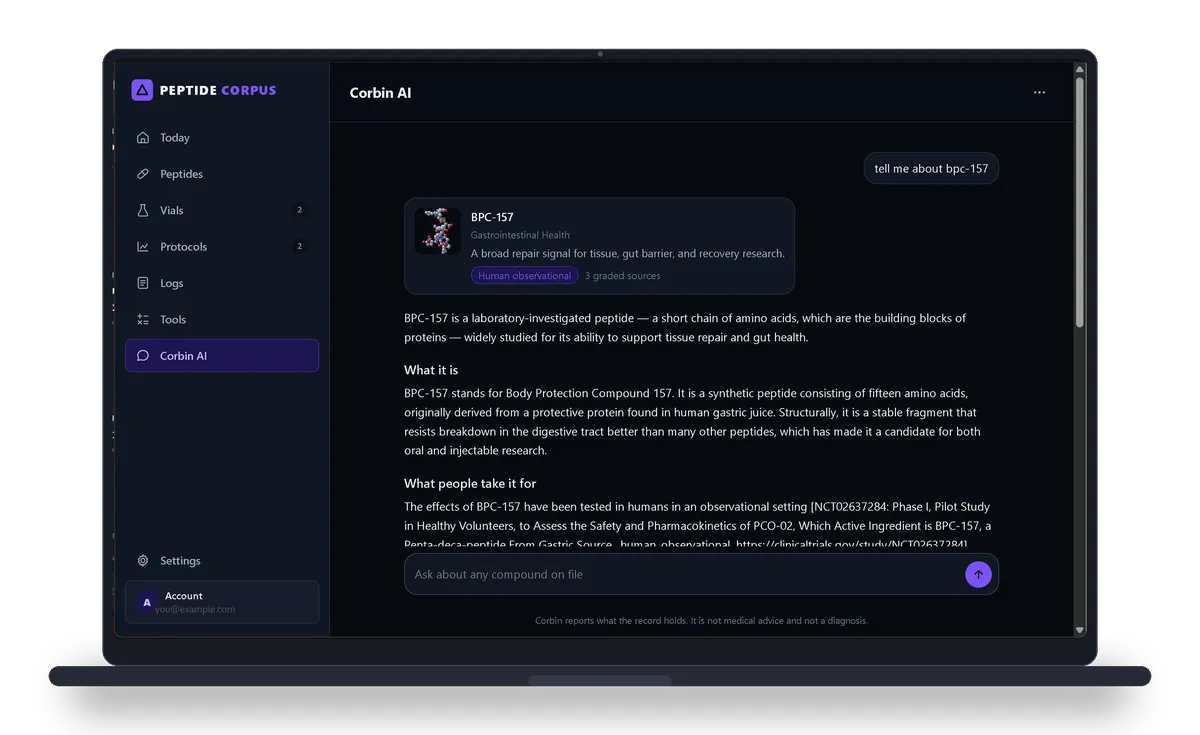
The Corbin AI screen answering a question about BPC-157, with a compound card showing its evidence tier and its graded sources above the answer. The Corbin AI screen answering a question about BPC-157, with a compound card showing its evidence tier and its graded sources above the answer.
Ask Corbin anything on fileOur own model, reading our own corpus. It shows the tier and the sources behind every answer, and ten questions a month are free.
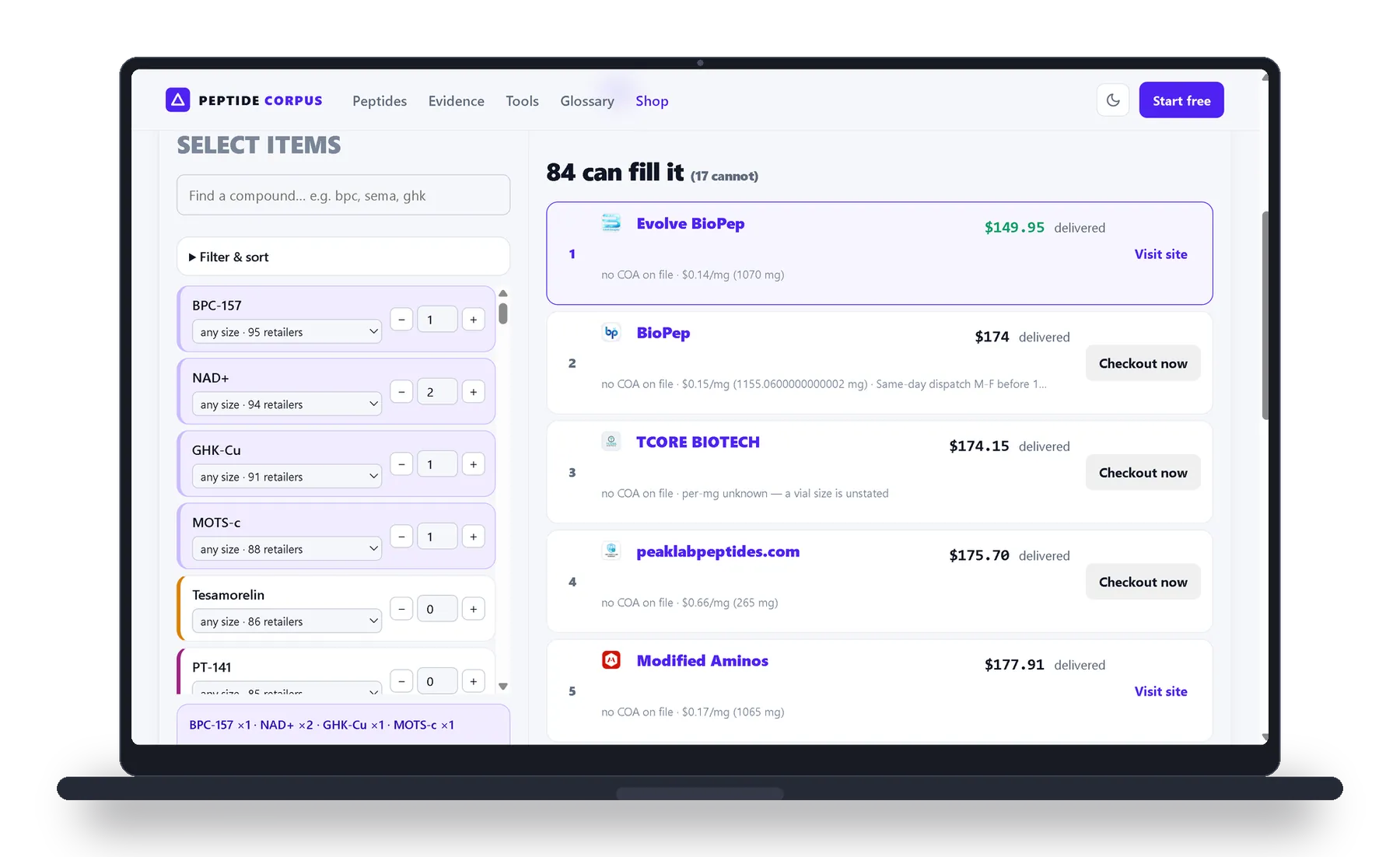
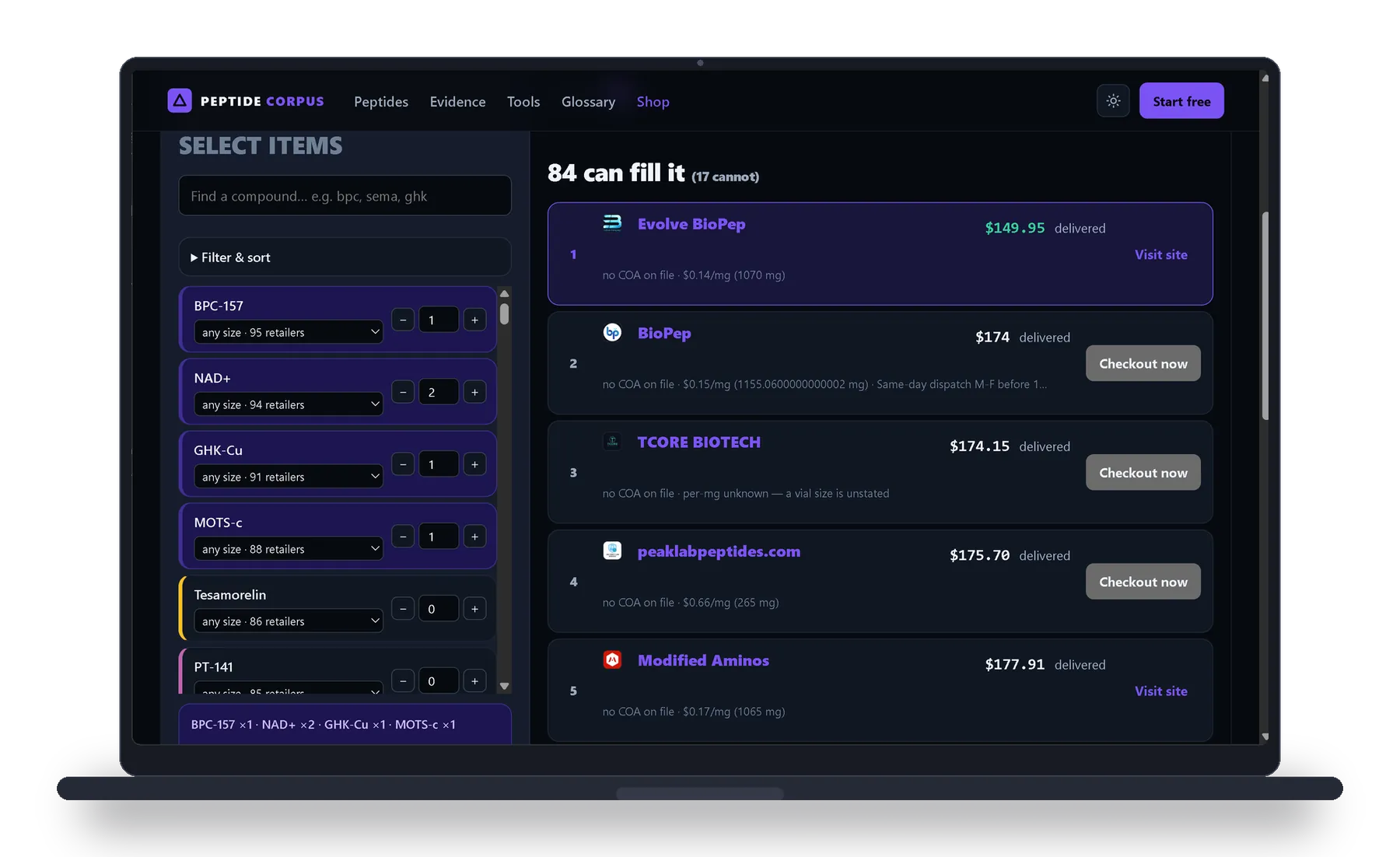
PerfectCart comparing one basket of four compounds across sellers, showing delivered totals and which sellers can supply the whole basket. PerfectCart comparing one basket of four compounds across sellers, showing delivered totals and which sellers can supply the whole basket.
One basket, every seller pricedPut four compounds in a basket and see who can ship all of them, and what each would cost delivered. Open PerfectCart.

Mix your first vial

Checked on their live sites, August 2026

Three things only we do

Measured against the four peptide references people actually use.

Capabilities unique to Peptide Corpus, compared with Peptide Protocol Wiki, Peptidepedia, Peptpedia and PeptideFox
Capability Peptide Protocol Wiki Peptidepedia Peptpedia PeptideFox Peptide Corpus
Can these two share a vialThe co-formulation check. Not one of the four answers it. No No No No Yes
Dose log, vials and protocolsA record that is yours and persists. The four are references; none of them is something you use over time. No No No No Yes
Every field counted, including the empty ones765 fields are recorded as not on file, with the reason. The others write about gaps; none of them counts them. No No No No Yes

The method, in the open

Where the data comes from

Seven rungs, strongest first. Rung 1 is a randomised human trial. A record qualifies for a tier or it does not, and you can check which.

  1. 1 human_rct Randomised, controlled, in people.
  2. 2 human_observational People, but no control arm.
  3. 3 human_case_series A handful of people, written up.
  4. 4 animal_in_vivo Whole animals, not people.
  5. 5 in_vitro Cells or tissue in a dish.
  6. 6 theoretical Argued from mechanism, not measured.
  7. 7 computational Modelled or docked in software.
  • Every grade names the phrase it came from

    A grade records the literal text it was derived from, so you can check the reading rather than trust it. 863 of the 1,062 citations carry one; the other 199 could not be placed and are left ungraded rather than guessed at.

  • Alias collisions raise, they do not merge

    When two names resolve to the same canonical term and should not, the taxonomy build fails. Nothing is quietly folded together.

  • The gap ledger is a real count

    765 fields across 163 records are marked "not on file". The ledger is browsable and the number moves when a source lands.

on device Calculations run in your browser, and what you type into them is never sent anywhere. The only third party these pages can reach is Google Analytics, and only if you accept it — reject the banner and nothing third-party loads.

Knowledge is free, your data is paid

Three plans. The corpus is in all of them.

Free

$0 always

No card. No trial clock. This tier is the product, not a sample of it.

Mix your first vial
  • All 188 compound records: 183 with an evidence tier, 765 declared gaps
  • The full grading rubric, and the gap ledger
  • Conditions, mapped to the compounds studied against them
  • Vendor directory: 213 of 225 sellers scored on 6 dimensions, 11 testing labs
  • Seven tools: reconstitution, beyond-use dates, dose scaling, vial check, stack checker, protocol builder, cost calculator
  • Glossary: 203 terms, 1,212 aliases resolved
  • Vial check: 6 co-formulation pairs on five axes
  • Bookmark any peptide
  • Articles: every claim in them sourced, with the gaps named
  • Wellness profile
  • Weight tracking, and the change since your first weigh-in
  • 10 Corbin AI messages a month

Pro

$4.99 a month

$44.99 a year if you pay annually — 25% off. Cancel any time.

Start Pro

Three steps: create your account, confirm your email, then pay.

Everything in Free, plus the app that keeps your record:

  • Saved vials, with the 28-day beyond-use clock
  • Protocols — as many as you run
  • Dose logging, with site and volume
  • Calendar linking: your doses in the calendar you already use
  • A discard date on every vial, marked on the month grid
  • 30 Corbin AI messages a month

Ultra

$14.99 a month

$119.99 a year if you pay annually — 33% off. Cancel any time.

Start Ultra

Three steps: create your account, confirm your email, then pay.

Everything in Pro, plus the things that need your history:

  • The journal — sleep, mood, stress and your own side-effect notes
  • Food logging, on the same timeline as your doses
  • Export your full report
  • A Today page that reacts to what you logged
  • Blood test upload, and tracking over time
  • Corbin AI without a limit, as an agent

The 188 peptide records are never gated, for anyone, signed in or not.