Reading a certificate of analysis
Everyone asks for a COA. Almost nobody has been told what one is. Learn to read the four lines on it and you can see straight through most of this market.
Last updated
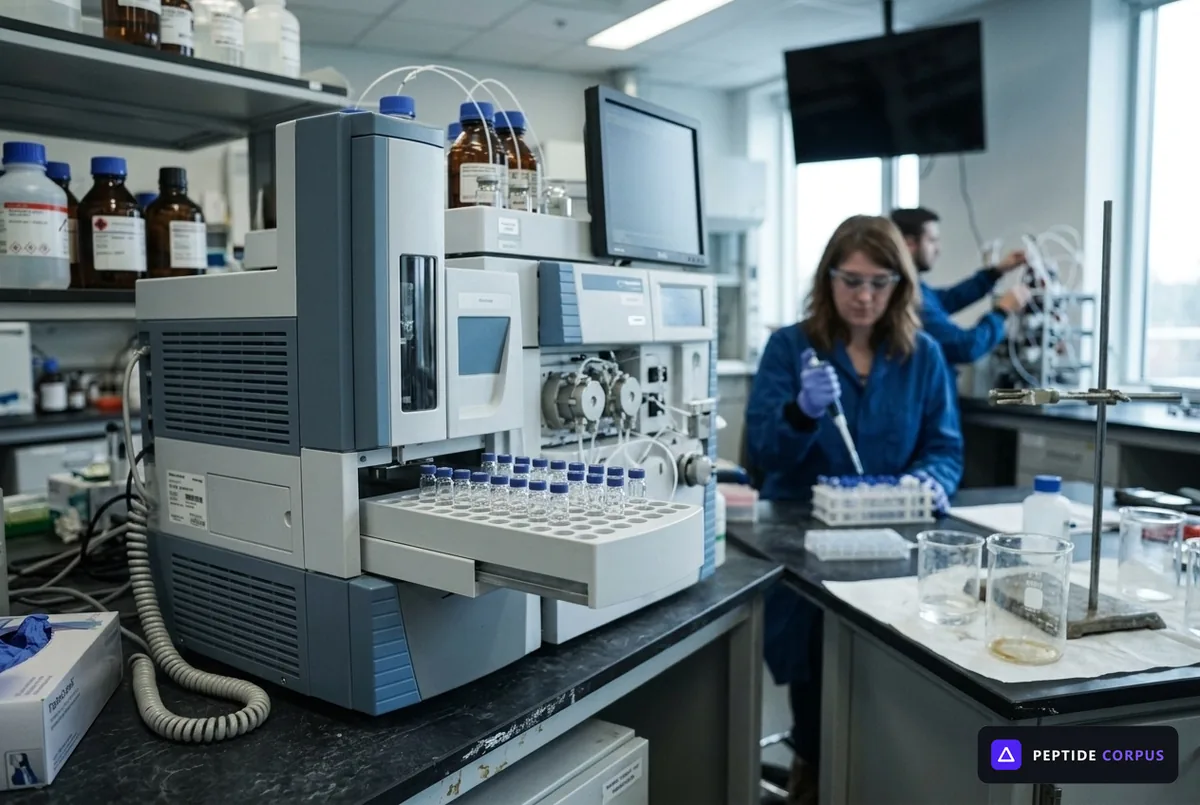
A certificate is not an independent report
Learning to read a certificate of analysis is the highest-leverage afternoon available to anyone buying in this market, and it starts by throwing away the definition everybody repeats. The common one calls a COA an independent laboratory report verifying identity and purity. It is wrong on the load-bearing word.
A certificate is issued by whoever performed the analysis — ordinarily the manufacturer's own quality unit, or a contract laboratory the manufacturer chose and paid. ICH Q7, adopted by the FDA as guidance, describes it as dated and signed by the quality unit of the manufacturer. Independence is simply not part of the definition.
Third-party certificates are real and worth seeking out. The point is that independence is an optional extra somebody arranged and paid for, not a property the document acquires by being a certificate. And nothing inside the PDF ties it to the vial on your desk: the tested sample and the shipped vial are joined by the seller's word about a batch number, and by nothing else.
What the document is
A record of results from tests someone ran on some material, signed by whoever ran them.
- Issued by the manufacturer's quality unit in the ordinary case
- Names a batch; the link to your vial is the seller's claim
- Third-party testing is a separate arrangement, stated or absent
What it is not
It is not an inspection, not an accreditation, and not evidence that anyone outside the supply chain looked at the material.
- Independence is a claim on the page, not a definition
- A laboratory name is not an accreditation status
- ISO/IEC 17025 is granted for a defined scope of methods
Purity is a ratio between peaks
The chemistry here is lovely, and knowing it changes what the number means. Reversed-phase HPLC pushes a mixture down a column packed with hydrophobic particles: greasy molecules cling and travel slowly, soluble ones sprint, and a detector at the far end counts everything that comes off, usually at 214 or 220 nm. Purity is the area of the main peak divided by the total detected peak area.
Which makes it a proportion of what one detector saw at one wavelength. Not a quantity of peptide. Not a mass. And silent about anything that does not absorb, does not elute, or comes off the column at the same moment as the main peak.
Chromatography also cannot name the peak it is measuring. Assigning the dominant peak to the intended compound needs a qualified reference standard with a matching retention time, or an orthogonal method. A vial containing 99% of the wrong peptide produces a 99% certificate.
The number that actually governs a dose is a different one, and it is rarely printed. A lyophilised peptide salt carries counter-ion — trifluoroacetate or acetate — plus bound water. Bachem states that while research-use peptides are typically above 95% pure by HPLC, peptide content of the solid may run from 70 to 90%. A vial labelled by gross mass therefore overstates the peptide delivered by somewhere between 10 and 30%, and chromatographic purity will not tell you which end you are at.
What each test on a certificate answers
5 categories · 7 compounds| Test | Named on records for | Answers | Does not answer |
|---|---|---|---|
| RP-HPLC purity | BPC-157, TB-500 | Proportion of detected peak area belonging to the main peak | Identity, peptide content by weight, anything not UV-absorbing |
| Intact mass (LC-MS) | Semaglutide, CJC-1295 DAC | Whether the measured mass matches the theoretical mass | Sequence order, leucine versus isoleucine, D/L racemisation |
| Amino acid analysis | Ipamorelin | Residue ratios, and peptide content by mass | Sequence order; it destroys the peptide to count residues |
| Endotoxin (LAL) | Tesamorelin | Endotoxin units per unit of material | Whether that passes — the limit depends on the dose, not the vial |
| Sterility | Tirzepatide | That no organism grew from the containers examined | That the batch is sterile — it is a sample test, destructively run |
Mass confirms a number, not a sequence
Mass spectrometry is the closest thing on a certificate to a magic trick: it weighs a single molecule. A match tells you the elemental composition is consistent with the intended peptide, which is a genuinely powerful thing to know from a few micrograms of powder.
It also has three blind spots worth memorising. It cannot tell you the residues are in the intended order, because a sequence isomer weighs exactly the same. It cannot separate leucine from isoleucine, which are identical in mass. And it does not see racemisation at any position, though D-amino acid formation is one of the named synthesis-related impurity classes.
The accuracy figure quoted on certificates is often borrowed from a different class of instrument. Sub-5-ppm accuracy is high-resolution territory — Orbitrap and FT-ICR. The MALDI-TOF and single-quadrupole systems typical of research-peptide certificates work at roughly 0.1 to 1 Da. A certificate saying observed mass matches theoretical, with no acceptance window, has not stated a criterion at all.
Which brings us to the impurity that hides best. A deletion peptide missing a single glycine is 57 Da lighter than the target; missing a leucine, 113. Those are enormous, obvious gaps on any instrument. The dangerous one is the deletion that co-elutes with the main peak and never appears as a separate area on the chromatogram.
-
Synthesis-related
Deletion and insertion sequences from missed or doubled couplings, truncated chains, and residual coupling reagents. These are the characteristic impurities of solid-phase synthesis and are catalogued in the peptide impurity literature as a class.
-
Degradation-related
Oxidation at methionine, cysteine, tryptophan and histidine; deamidation of asparagine and glutamine, whose mechanism differs above and below neutral pH; aggregation into dimers and oligomers. The documented consequence of oxidation is usually loss of activity rather than a new one.
-
Process residues
Counter-ion, water, residual solvent and inorganic residue. None of these absorbs where the detector is looking, so none appears in the purity percentage — and together they are the reason peptide content by weight sits below chromatographic purity.
The endotoxin line needs a limit to mean anything
Endotoxin is the line on the page with the sharpest teeth. It is lipopolysaccharide from the cell wall of gram-negative bacteria, recognised by TLR4, and it drives interleukin-1β, interleukin-6 and TNF-α release and produces fever. It also survives sterilisation, which is exactly why a sterility result and an endotoxin result answer two different questions.
A number of endotoxin units on its own is uninterpretable, and this is the trick worth knowing. USP <85> sets the limit as K divided by M — K being 5 EU per kilogram of body weight per hour for parenteral routes, M the maximum dose per kilogram in that hour. The limit is a function of the dose, not of the vial. A result of 10 EU per vial is comfortably inside the limit at one dose and outside it at another, so a certificate printing the result without the dose it was assessed against has printed half a test.
Sterility has a similar gap between what is stated and what is shown. A compendial sterility test examines a sample of containers from a batch and reports that nothing grew under the conditions of the test. It cannot demonstrate that the batch contains no viable organism, and no certificate should be read as claiming so.
There is no purity standard to fail
Here is the part that reframes every number above. The 95% and 98% thresholds quoted across this market are supplier grade bands — commercial product tiers set by vendors against intended application, not floors set by a standards body. No pharmacopoeia and no regulator publishes a minimum purity percentage for research-grade peptides, for the plain reason that most of these compounds have no monograph at all.
Approved pharmaceutical peptides are governed far more tightly, but still not by a total-purity number: the framework is per-impurity thresholds set in each product's own specification. So a 98% claim tells you where a vendor filed a product in its own catalogue, and comparing 98% from one seller with 99% from another compares two conventions rather than two measurements.
One measured figure is worth more than everything else on this page. In a 2024 study of online semaglutide purchases, three of six orders arrived at all. Every one that did was labelled 99% purity. They measured between 7.70% and 14.37%.
- Certificate of analysis
- A dated, signed record of test results for a batch, issued by whoever performed the analysis. Independence is a separate claim that must be stated and evidenced.
- Chromatographic purity
- Main peak area divided by total detected peak area, at one detection wavelength. A ratio, not a mass.
- Peptide content
- The proportion of the solid that is peptide rather than counter-ion, water or salt. Typically 70 to 90% for research-grade material. Determined by amino acid analysis or nitrogen determination, not by HPLC.
- Endotoxin limit
- K divided by M, where K is 5 EU/kg/hour for parenteral administration and M is the maximum hourly dose per kilogram. A property of the dose, not of the vial.
- ISO/IEC 17025
- An accreditation of a laboratory's competence for a defined scope of methods. A laboratory can hold it for methods unrelated to the test on the certificate in front of you.
- Isobaric
- Having the same mass. Leucine and isoleucine are isobaric, so mass spectrometry cannot tell them apart.
Sources and evidence
Sources and evidence
10 sourcesMcCarthy D, Han Y, Carrick K, et al. Reference Standards to Support Quality of Synthetic Peptide Therapeutics. Pharm Res. 2023Peer-reviewed review
How this source supports the article
That chromatographic purity is an area percentage rather than a mass assay; that assigning the main peak to the target requires a qualified reference standard or an orthogonal identity method; and that amino acid analysis is the route to peptide content by weight.
Limitations
A review of reference-standard practice for pharmaceutical peptides. It is written about the regulated supply chain, and none of its framework is applied to research-use-only material.
D'Hondt M, Bracke N, Taevernier L, et al. Related impurities in peptide medicines. J Pharm Biomed Anal. 2014Peer-reviewed review
How this source supports the article
The three impurity classes in this article — synthesis-related, degradation-related and process residues — and the specific named species: deletion and insertion sequences, truncation, oxidation, deamidation, racemisation and aggregation.
Limitations
It classifies impurities structurally and does not characterise them as biologically hazardous. The functional consequence of most individual impurities is not established, and the review says so.
USP General Chapter <1503> Quality Attributes of Synthetic Peptide Drug Substances. USP-NF, official 1 August 2021Pharmacopoeial chapter
How this source supports the article
That quality attributes for synthetic peptides are set per product in a specification, and that there is no universal total-purity floor of the kind the market quotes.
Limitations
A general information chapter for drug substances. It has no application to material sold outside the drug framework, which is precisely the material most certificates in this market describe.
GenScript. Recommended Peptide Purity Guidelines (supplier technical page)Supplier technical page
How this source supports the article
That 95% and 98% are supplier grade bands defined against intended application — the ladder is published by the supplier itself, which is the point being made.
Limitations
A commercial page from one supplier. It documents a convention rather than establishing a standard, and other suppliers band their catalogues differently.
Bachem. Care and Handling of Peptides (Knowledge Center)Supplier technical page
How this source supports the article
The 70-to-90% peptide-content range for research-grade solid, and the reason for it: counter-ions such as acetate or trifluoroacetate, plus bound water.
Limitations
Supplier guidance, not a measured survey. The range is a typical case, not a bound — an individual lot can fall outside it, and only an assay on that lot would show it.
FDA/ICH Q7 Good Manufacturing Practice Guidance for Active Pharmaceutical Ingredients, section 11.4Regulatory guidance
How this source supports the article
That a certificate of analysis is dated and signed by the quality unit of the manufacturer — the basis for this article's opening correction about independence.
Limitations
Applies to active pharmaceutical ingredients made under GMP. It describes what a certificate is in a regulated setting; it does not govern documents issued alongside research-use-only material.
USP General Chapter <85> Bacterial Endotoxins Test — endotoxin limit K/MPharmacopoeial chapter
How this source supports the article
The endotoxin limit formula K/M, and K = 5 EU per kilogram per hour for parenteral routes — the reason an endotoxin result without a dose is not a pass or a fail.
Limitations
The chapter text sits behind a subscription. The formula and the K value were read from an independent testing-industry restatement rather than from the chapter itself, so the wording here is a paraphrase of a paraphrase.
Ashraf AR, Mackey TK, Vida R, et al. Safety and Risk Assessment of No-Prescription Online Semaglutide Purchases. J Med Internet Res. 2024;26:e65440Human observational
How this source supports the article
The measured figures closing this article: of six no-prescription online semaglutide orders, three arrived; all three were labelled 99% purity and assayed between 7.70% and 14.37%.
Limitations
Six orders, three delivered. That is a very small sample and cannot support a rate for the market. It establishes that the failure mode occurs, not how often.
Rosenberg AS. Effects of protein aggregates: an immunologic perspective. AAPS J. 2006;8(3):E501-E507Peer-reviewed review
How this source supports the article
That aggregated species can provoke an antibody response by cross-linking B-cell receptors, which is why aggregation is listed here as an impurity class with a consequence rather than a cosmetic defect.
Limitations
The evidence concerns therapeutic proteins. Aggregate immunogenicity depends on multivalent, arrayed epitope display, which is a property of large particles more than of a short peptide — the mechanism does not transfer to peptides unchanged.
ISO/IEC 17025:2017, General requirements for the competence of testing and calibration laboratoriesInternational standard
How this source supports the article
That accreditation is granted against a defined scope of methods — the basis for the caution that holding 17025 and being accredited for the test on your certificate are two different statements.
Limitations
The standard is paywalled and was not read in full. What is used here is its scope-based structure, which is stated in the public abstract and in accreditation bodies' own guidance.