Travelling with a protocol
Two agencies, two entirely different questions, and almost every guide on the internet answers one and reports it as the other. Sort that out and travelling gets a great deal simpler.
Last updated
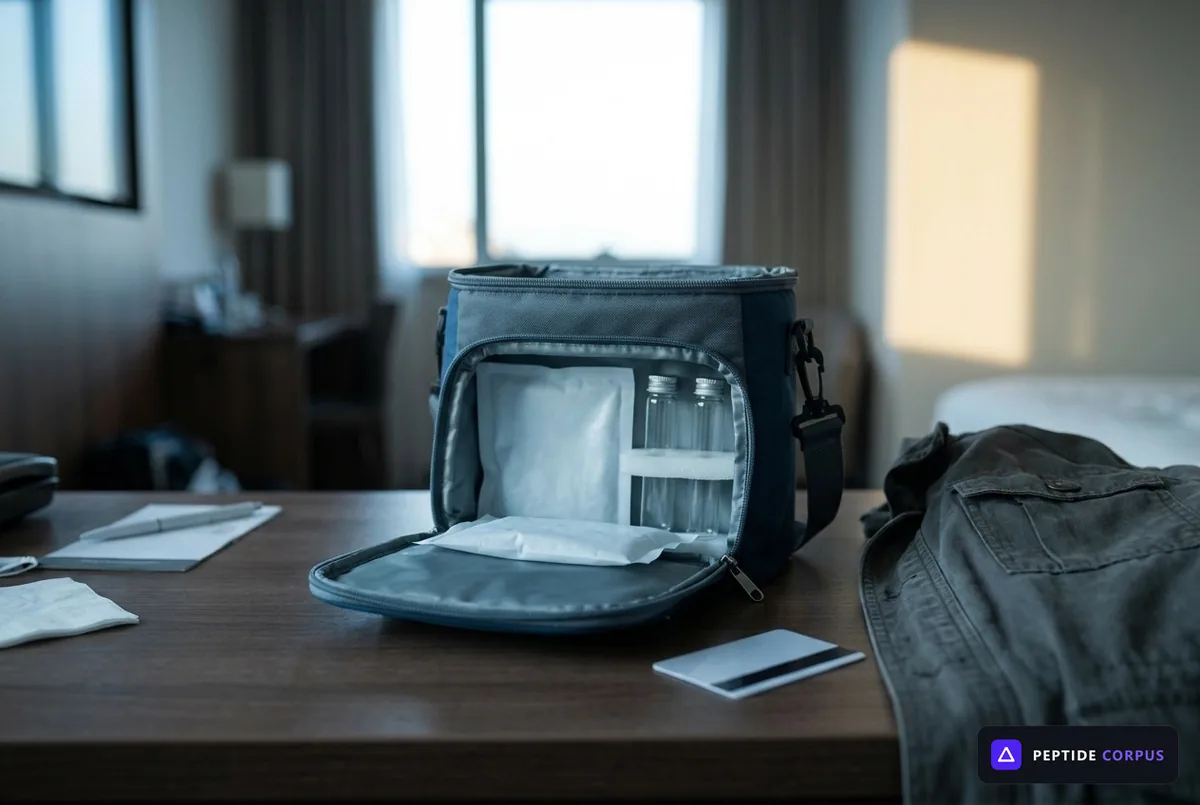
Two agencies, two questions
Travelling with a protocol is far more manageable than the forums suggest, and it gets simpler the moment you split one question into two. "Will security let this through" and "is this lawful to carry into the country I am entering" are decided by different bodies with different jobs. Screening authorities look for threats to aviation and say so plainly. Whether a substance may lawfully be imported belongs to the drug regulator and the customs service of wherever you land.
Collapse the two and you get errors pointing in opposite directions. Clearing a checkpoint feels like an answer to a question the checkpoint never asked. Meanwhile a rule that genuinely bites at a border gets written up in the language of screening, as though the verdict travelled along with the bag.
Airport screening
Decides whether an item may pass the checkpoint onto an aircraft. Publishes per-item pages, each with its own last-updated date.
- Medically necessary liquids are exempt from the 3.4-ounce rule
- Gel ice packs are permitted regardless of physical state
- The final decision rests with the officer, on every item page
Import and customs
Decides whether a substance may lawfully enter a country. Nothing about a cleared checkpoint speaks to this.
- Each destination applies its own rule
- A prescription has no legal standing outside the country that issued it
- Research use only is a seller's label, not a legal category
What the screening pages actually say
The good news is that the screening rules are published, specific, and more generous than most people expect. TSA exempts medically necessary liquids from the 3-1-1 rule with three conditions in the same sentence: medically necessary, a quantity reasonable for the trip, and declared. Unused syringes are permitted when they accompany the injectable medication they are for, and TSA's wording adds that they be declared for inspection. Gel ice packs and freezer packs are permitted for medically necessary liquids whether they are frozen, melted or slushy.
Two details get dropped every time that paragraph is repeated. The first is the standing line on every item page: the final decision rests with the officer at the checkpoint. Following the procedure improves your odds and does not create an entitlement — TSA Cares says outright that a medically necessary liquid whose alarm cannot be resolved may not be allowed through.
The second is what "medically necessary" is quietly doing. It is the word the whole exemption turns on. A prescribed, pharmacy-labelled medicine is the case it plainly covers. Material sold as research use only, carried without a prescription, is the case it plainly does not — and asserting medical necessity to a federal officer is a statement of fact, not a useful form of words.
One popular instruction runs backwards, and this is the easiest win of the whole trip. Keeping everything sealed in one case gets passed around as good practice; TSA asks for the opposite at the checkpoint, which is to take medically necessary items out of the carry-on and put them in a bin. Fly with a cooled case, by all means. Just open it when you reach the belt.
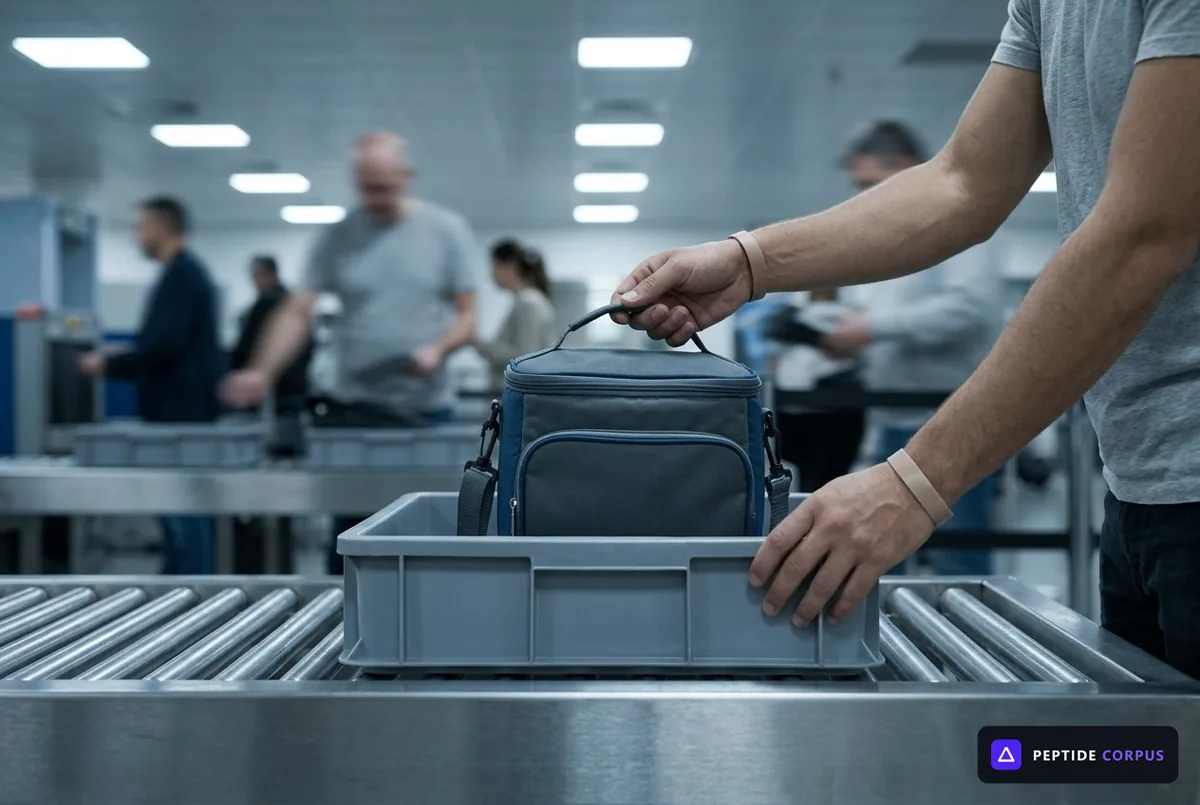
The temperature rules are on the label
Here is where travel gets easier rather than harder, because the real storage windows are wider than the flat "2 to 8 °C at all times" rule everyone quotes. After first use, a semaglutide pen may be stored for 56 days at controlled room temperature between 15 and 30 °C, or refrigerated. Tirzepatide may be stored at up to 30 °C for 21 days. Those are the licensed in-use conditions, printed in the label's storage section. A stricter rule invented on top of them is not caution — it is a different rule with nobody's name on it.
Dried peptide is looser still, and honestly so. NIBSC describes dry peptides as stable at room temperature for days to weeks, recommends 4 °C or colder, and puts long-term storage at −20 °C. That is a range with an order of magnitude inside it, not the tidy one-to-two-week figure that circulates, and no source establishes the tidy one.
The chemistry underneath is worth knowing, partly because it is elegant and partly because the usual shorthand invents a mechanism that does not exist. Heat drives deamidation — an asparagine or glutamine side-chain amide hydrolysing to a carboxylic acid by way of a succinimide intermediate — and oxidation, mostly at methionine. Water is a reactant in both, which is exactly why a reconstituted vial ages faster than a dry one. Nothing here shatters or shears, and domestic freezing does not break covalent bonds. Freeze damage to proteins comes from three stresses: low temperature itself, freeze-concentration of solutes, and the ice-water interface — with ice formation the dominant destabiliser in at least one controlled study.
In-use storage, as printed on approved labels
4 categories · 4 compounds| Product | Record | Licensed in-use window | What the label does not say |
|---|---|---|---|
| Semaglutide pen, after first use | Semaglutide | 56 days at 15–30 °C, or refrigerated at 2–8 °C | Nothing about a 25 °C ceiling — that threshold has no source |
| Tirzepatide, after first use | Tirzepatide | 21 days at up to 30 °C | Nothing permitting freezing; the do-not-freeze instruction is real |
| Bacteriostatic water for injection | 0.9% or 1.1% benzyl alcohol, per the USP monograph product | No 28-day statement appears anywhere in the label text | |
| Lyophilised research peptide | BPC-157, Ipamorelin | Days to weeks at room temperature, per NIBSC; −20 °C long term | Any single figure — the published range spans an order of magnitude |
Where the 28 days comes from
The 28-day figure is real, and tracing it back is genuinely satisfying, because it does not come from bacteriostatic water and it is not a shelf life. The FDA label for Bacteriostatic Water for Injection contains no 28-day statement anywhere. Twenty-eight days is the default beyond-use date USP <797> assigns to a preserved multiple-dose container once it has been entered or punctured, unless the manufacturer specifies otherwise.
Three things fall out of that sentence, and each one goes missing somewhere in the retellings. The clock starts at first puncture, not at reconstitution. It is a microbiological limit — it says how long the preservative can be relied on against contamination introduced by repeated entry, and nothing whatsoever about whether the peptide is still intact. And it yields to a manufacturer-specified date: several approved products carry in-use windows shorter than 28 days, so treat the figure as a ceiling rather than a constant.
The BAC-water calculator on this site applies 28 days from first puncture, refrigerated. That is the default, and the default is what the record says when nothing more specific exists.
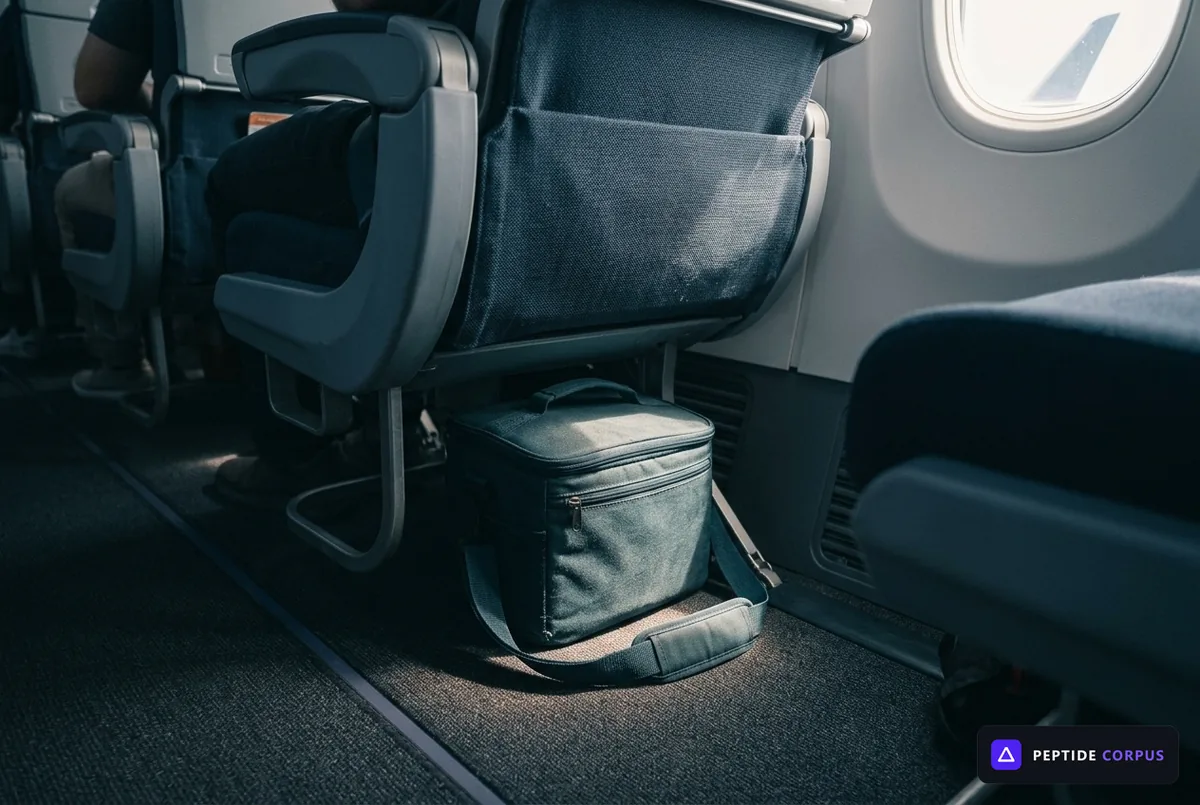
Cargo hold, and the rule nobody publishes
"Never pack peptides in checked luggage" is repeated as a rule by a great deal of travel advice and by no authority at all. TSA lists liquid medications and unused syringes as permitted in checked bags. There are two genuinely good arguments for taking them into the cabin, and both beat the invented rule: manufacturer instructions not to freeze the product, and the ordinary misery of being separated from your medication when a bag goes wandering.
The hold-temperature claim deserves the same care. Baggage holds on passenger aircraft are heated and pressurised; the case for extremes is stronger during long waits on the ground than at cruise. Where freezing does happen, the damage comes from ice formation and freeze-concentration, which is a real risk to a formulated protein and not the bond-shattering event the phrase implies.
Crossing a border is a separate decision
The border is the one place to slow down, and the rule is simple enough to carry in your head: every destination applies its own import law, and a pharmacy label from one country has no legal standing in another. Semaglutide and tirzepatide are prescription-only medicines rather than controlled substances in the United States, the United Kingdom and Australia, which is why a labelled, prescribed product is the straightforward case. That is narrower and more checkable than any claim about a universal medical defence, and it is what the sources actually support.
Research-use material is a different kind of thing entirely. "Research use only" is a labelling convention used by sellers, not a legal category authorising human use — in US regulation the phrase belongs to in vitro diagnostic products, and intended use governs the rest. No border agency publishes a seizure rate for research peptides, so anyone quoting you a risk level is quoting nothing.
One last claim, and we would be the beneficiary of it, so we will name it ourselves. A reference database cannot tell you whether the vial in your bag has degraded or been contaminated. Those are properties of one physical vial, established by assaying that vial. The corpus can tell you what the record says about a compound. It cannot tell you what is in your luggage.
- Beyond-use date
- The date after which a compounded or entered preparation should not be used. Set from first puncture for a preserved multiple-dose container, defaulting to 28 days unless the manufacturer specifies otherwise.
- Bacteriostatic water
- Sterile water containing benzyl alcohol as a preservative, supplied at 0.9% or 1.1% under the USP monograph.
- Deamidation
- Hydrolysis of an asparagine or glutamine side-chain amide to a carboxylic acid, via a succinimide intermediate. Accelerated by temperature and pH. The covalent change is irreversible; whether activity changes is site-dependent.
- Thermolabile
- Readily altered by moderate heat. A property of a particular sequence and formulation, not of peptides as a class — two approved peptide products are licensed for weeks at up to 30 °C.
- Cold chain
- A temperature-controlled handling and storage path, conventionally 2 to 8 °C. Standard for distribution; not a universal requirement in use.
- 3-1-1 exemption
- The screening carve-out for medically necessary liquids from the standard container-size limit, conditional on necessity, reasonable quantity, and declaration.
Sources and evidence
Sources and evidence
15 sourcesTransportation Security Administration. TSA Cares — Disabilities and Medical ConditionsGovernment guidance
How this source supports the article
The 3-1-1 exemption for medically necessary liquids and its three conditions; the instruction to inform the officer before screening begins; the instruction to remove medically necessary items into a bin; and the statement that an unresolvable alarm may mean the item is not allowed.
Limitations
Guidance rather than regulation, revised without notice, and applicable only to screening in the United States. It settles nothing about whether an item may lawfully be carried or imported.
Transportation Security Administration. What Can I Bring? — Medications (Liquid), last updated 9 October 2024Government guidance
How this source supports the article
That liquid medications are listed as permitted in both carry-on and checked bags, which is the basis for describing the never-check-them rule as unsourced.
Limitations
A per-item page carrying its own date. It states a category permission, not a determination about any particular substance, and the officer's discretion line applies to it.
Transportation Security Administration. What Can I Bring? — Unused Syringes, last updated 16 November 2017Government guidance
How this source supports the article
That unused syringes are permitted when accompanied by the injectable medication, and that they must be declared to security officers for inspection.
Limitations
Last updated in 2017. It also carries the standing line that the final decision rests with the officer, which is why this article does not describe the permission as a guarantee.
Transportation Security Administration. What Can I Bring? — Gel Ice Packs, last updated 17 May 2022Government guidance
How this source supports the article
That gel ice packs accompanying medically necessary liquids are permitted regardless of their physical state — melted or slushy included.
Limitations
The permission is tied to the accompanying liquid being medically necessary. It does not extend the exemption to whatever the pack is cooling.
Novo Nordisk. OZEMPIC (semaglutide) injection — full prescribing information, section 16 Storage and HandlingApproved product label
How this source supports the article
The 56-day in-use window at 15 to 30 °C or refrigerated, which is the counter-example to the flat strict-refrigeration rule and to the 25 °C threshold.
Limitations
Applies to one formulation of one product in its own pen. It does not transfer to compounded semaglutide, to a research vial, or to any other peptide.
Eli Lilly. MOUNJARO (tirzepatide) injection — Patient Information, storage sectionApproved product label
How this source supports the article
The 21-day window at up to 30 °C, and the manufacturer's do-not-freeze instruction — the strongest sourced argument for carrying product into the cabin.
Limitations
Product-specific in the same way as the semaglutide label. The do-not-freeze instruction is about this formulation, not a general property of peptides.
Hospira, Inc. BACTERIOSTATIC WATER for Injection, USP — FDA package insertApproved product label
How this source supports the article
The 0.9% and 1.1% benzyl alcohol presentations, and the negative finding that the label contains no 28-day statement anywhere in its text.
Limitations
One manufacturer's insert. The absence of a 28-day statement is a fact about this label; it is evidence that the figure comes from elsewhere, which is the point made here.
United States Pharmacopeia. General Chapter <797> Pharmaceutical Compounding — Sterile Preparations, beyond-use dating for multiple-dose containersPharmacopoeial chapter
How this source supports the article
That 28 days is a default beyond-use date for a preserved multiple-dose container after first entry or puncture, unless the manufacturer specifies otherwise — and that it is a microbiological limit, not a stability figure.
Limitations
Read from a state health department's reproduction of the chapter rather than from USP directly, because the chapter is paywalled. The chapter governs compounding practice and was not written about consumer handling.
National Institute for Biological Standards and Control. Peptide Handling, dissolution & StorageInstitutional guidance
How this source supports the article
That dry peptides are described as stable at room temperature for days to weeks, with 4 °C or colder recommended and −20 °C for long-term storage — the range that replaces the unsourced one-to-two-week figure.
Limitations
A laboratory handling page inside a CJD resource centre, whose most recent visible date stamp is 2003. It recommends storing peptide solutions at −20 °C or colder, which is stricter than any consumer guidance and is about laboratory stocks.
Manning MC, Chou DK, Murphy BM, Payne RW, Katayama DS. Stability of protein pharmaceuticals: an update. Pharm Res. 2010;27(4):544-75Peer-reviewed review
How this source supports the article
That temperature drives chemical degradation — deamidation, oxidation, hydrolysis — and physical degradation by aggregation, and that solution-phase degradation is generally faster than the dried state because water is a reactant.
Limitations
A review of protein pharmaceuticals. It gives mechanisms and their drivers, not a rate for any peptide in this article, and it supplies no temperature threshold.
Robinson NE, Robinson AB. Deamidation of human proteins. PNAS. 2001;98(22):12409-13Peer-reviewed study
How this source supports the article
The deamidation mechanism as stated here: asparagine or glutamine side-chain amide to carboxylic acid via a succinimide intermediate, with rate dependent on sequence context.
Limitations
Concerns human proteins rather than synthetic peptides, and establishes that the change is covalent and irreversible — not that biological activity is necessarily lost, which is site-dependent.
Bhatnagar BS, Bogner RH, Pikal MJ. Protein stability during freezing: separation of stresses and mechanisms of protein stabilization. Pharm Dev Technol. 2007;12(5):505-23Peer-reviewed review
How this source supports the article
The three freezing stresses named here — low temperature, freeze-concentration of solutes, and ice formation at the ice-water interface — replacing the shattered-bonds description.
Limitations
Formulation science for proteins, studied under controlled freezing. It does not model a cargo hold, and it says nothing about how often baggage actually freezes.
U.S. Food and Drug Administration. Personal Importation, Import BasicsRegulatory guidance
How this source supports the article
That import is a separate regulatory question from screening, governed by the drug regulator and enforced at the border — the structural point this article is built on.
Limitations
Governs the United States inbound leg only. It has nothing to say about the rules of any destination country, which is where most of this question actually lands.
GOV.UK. Take medicine in or out of the UKGovernment guidance
How this source supports the article
That a destination applies its own rule to medicines carried in, which is the basis for stating that a prescription has no standing outside the country that issued it.
Limitations
One country's guidance, and the only one of the destinations commonly named that could be verified from a primary authority here. Nothing in it supports a claim about any other jurisdiction.
U.S. Food and Drug Administration. Distribution of In Vitro Diagnostic Products Labeled for Research Use Only or Investigational Use OnlyRegulatory guidance
How this source supports the article
That research use only is a labelling policy for in vitro diagnostic products, not a category applying to injectable peptides — the basis for calling it a seller's convention rather than a legal status.
Limitations
A device-labelling guidance. It establishes what the phrase means where it is defined; it does not itself address peptide sellers, and no guidance does so directly.