Cardiovascular & General; Sleep, Mood & Stress / Cardiovascular
Urotensin II
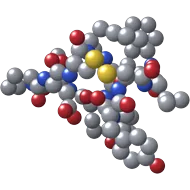
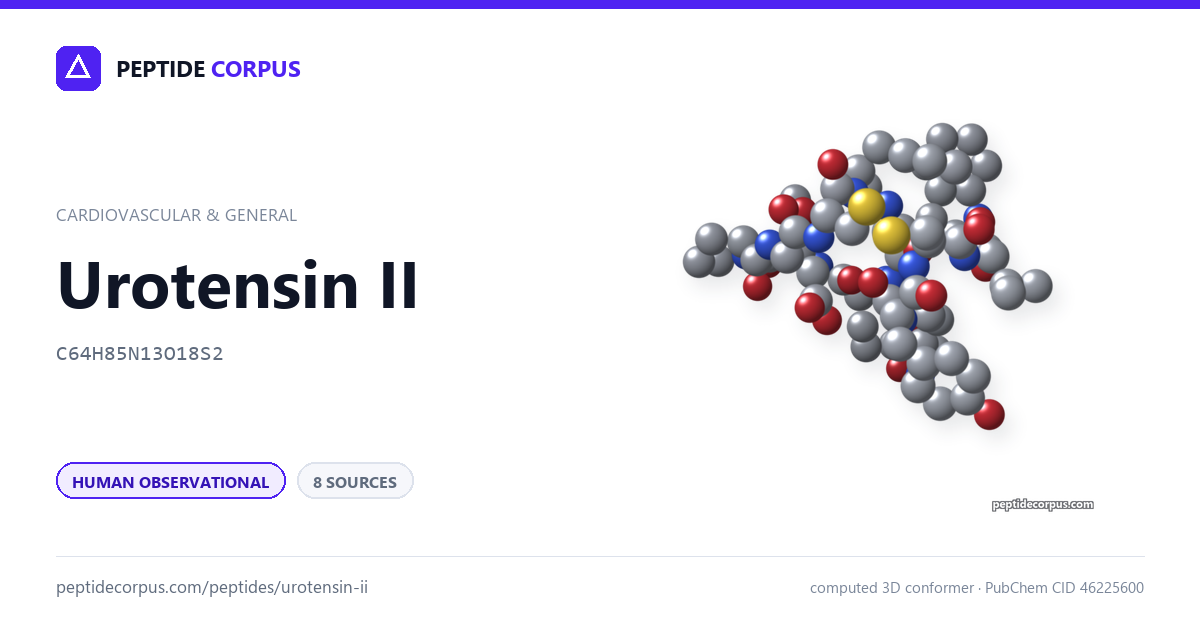
Urotensin II is a small ring-shaped peptide and the most potent constrictor of blood vessels identified in any mammal. It arrived in human pharmacology in 1999 by way of an orphan: a receptor called GPR14 that had no known partner, matched to this peptide and then renamed after it. That potency is precisely why nobody is developing urotensin II as a treatment — the clinical effort has gone entirely into drugs designed to block it, and the human studies on file measure its levels in liver cirrhosis, kidney disease and heart disease rather than administering it. It is a research peptide and a drug target, not a therapy, and no approved product contains it.
Last updated
Mechanism
Agonist at the UT receptor (formerly orphan GPR14) on vascular smooth muscle, producing sustained vasoconstriction.
Reported effects
What sources associate with this compound. Reported categories, not outcomes we have graded — each would need its own citation and rung.
- Vascular tone research
- Cardiovascular disease markers
- Receptor pharmacology
Dosing on file unverified
No established human therapeutic dose; research infusions only
Carried from a source that labels it unverified, and reproduced with that label attached. A record of what is reported, not a recommendation. No citation on this page establishes it.
Literature on file 8
-
animal in vivo
Human urotensin-II is a potent vasoconstrictor and agonist for the orphan receptor GPR14 (Nature 1999, cited 671x) graded on: an animal model — read from the indexed abstract — “rats”
- animal in vivo
-
in vitro
In-vitro effects of the urotensin-II peptide and its receptor antagonists on mcf-7 breast cancer cell line. graded on: an in-vitro system — “cell line”
-
animal in vivo
Capsanthin Attenuates Osteoporosis by Targeting the Urotensin II Receptor Pathway to Inhibit Oxidative Stress and NLRP3 Inflammasome Activation. graded on: an animal model — read from the indexed abstract — “mice”
- animal in vivo
-
animal in vivo
Involvement of gap junction, calcium and potassium channels in Urotensin II reactivity in diabetic rat isolated aorta. graded on: an animal model — “rat”
Not graded
2 citations whose study design could not be read from the title. Left ungraded rather than guessed at.
- not graded
-
not graded
NCT00163995: Urotensin II and Vascular Tone in Cirrhosis graded on: NCT00163995 is unknown and has posted no results - a registration, not a reported outcome — “NCT00163995”
Identity
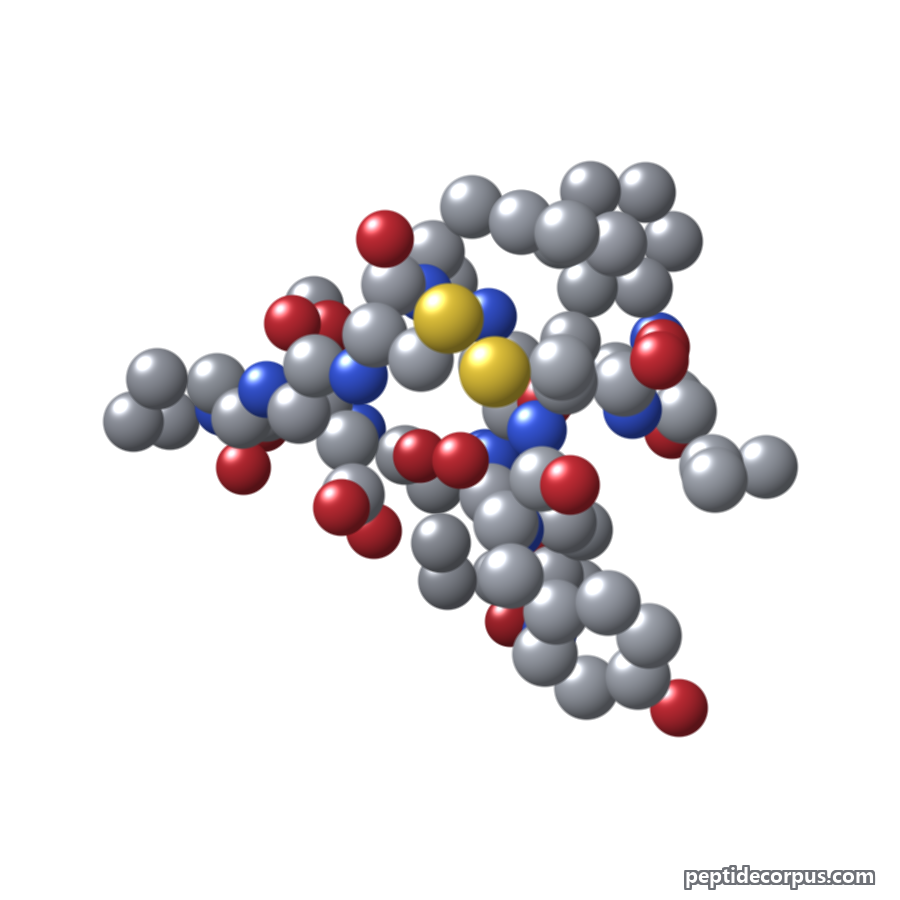
Skeletal formulathe canonical depiction
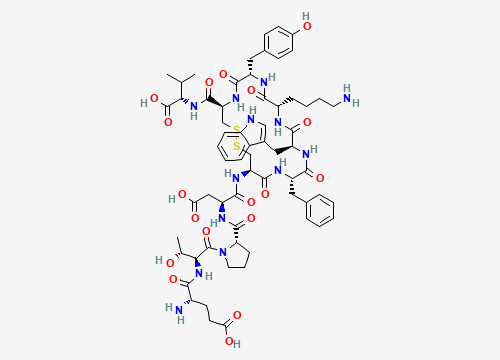
Drawn by PubChem from CID 46225600, the identifier on this record.
- Molecular weight
- 1388.6
- Molecular formula
- C64H85N13O18S2
- CAS number
- 9047-55-6
- PubChem CID
- 46225600
- InChI key
- HFNHAPQMXICKCF-USJMABIRSA-N
- SMILES
- C[C@H]([C@@H](C(=O)N1CCC[C@H]1C(=O)N[C@@H](CC(=O)O)C(=O)N[C@H]2CSSC[C@H](NC(=O)[C@@H](NC(=O)[C@@H](NC(=O)[C@@H](NC(=O)[C@@H](NC2=O)CC3=CC=CC=C3)CC4=CNC5=CC=CC=C54)CCCCN)CC6=CC=C(C=C6)O)C(=O)N[C@@H](C(C)C)C(=O)O)NC(=O)[C@H](CCC(=O)O)N)O
- InChI
- InChI=1S/C64H85N13O18S2/c1-33(2)52(64(94)95)75-61(91)48-32-97-96-31-47(73-59(89)46(29-51(82)83)72-62(92)49-17-11-25-77(49)63(93)53(34(3)78)76-54(84)40(66)22-23-50(80)81)60(90)70-43(26-35-12-5-4-6-13-35)56(86)71-45(28-37-30-67-41-15-8-7-14-39(37)41)58(88)68-42(16-9-10-24-65)55(85)69-44(57(87)74-48)27-36-18-20-38(79)21-19-36/h4-8,12-15,18-21,30,33-34,40,42-49,52-53,67,78-79H,9-11,16-17,22-29,31-32,65-66H2,1-3H3,(H,68,88)(H,69,85)(H,70,90)(H,71,86)(H,72,92)(H,73,89)(H,74,87)(H,75,91)(H,76,84)(H,80,81)(H,82,83)(H,94,95)/t34-,40+,42+,43+,44+,45+,46+,47+,48+,49+,52+,53+/m1/s1
Notes unverified prose
No FDA approval; preclinical only; no human therapeutic dosing; Phase 1 trials (antagonist); no approved therapeutic; preclinical
Not on file 2
1 of the 8 fields we track hold nothing on this record, and each says why. 1 further absence is named below. A blank field is a bug; a named absence is a finding.
- amino-acid sequencenothing we hold supplies it
- half-lifenothing we hold supplies it
Each field links to every other record missing the same thing. The full ledger holds 765 gaps across 163 records.
Share this record