Gastrointestinal Health
Uroguanylin
Eat something salty and the gut releases uroguanylin, which does two things at once: it tells the intestine to pour fluid into the bowel, and it signals the kidney about sodium — a direct line between the meal and what the kidney does next. Its practical legacy is a copy rather than itself. Plecanatide, a modified uroguanylin approved for chronic idiopathic constipation, carries a Phase 3 randomised trial, and that trial is what sets this record's evidence tier. Uroguanylin has not been given to people as a treatment, and the other reference on file is the 1993 paper that first purified it.
Last updated
Mechanism
Activates guanylate cyclase C on intestinal epithelium, raising cyclic GMP and driving chloride, bicarbonate, and water secretion.
Reported effects
What sources associate with this compound. Reported categories, not outcomes we have graded — each would need its own citation and rung.
- Intestinal secretion research
- Sodium balance research
- Gut-kidney axis context
Dosing on file unverified
Threshold: ~10 nmol/kg body weight (animal/human research)
Carried from a source that labels it unverified, and reproduced with that label attached. A record of what is reported, not a recommendation. No citation on this page establishes it.
Literature on file 2
-
animal in vivo
Uroguanylin: structure and activity of a second endogenous peptide that stimulates intestinal guanylate cyclase (Proceedings of the National Academy of Sciences 1993, cited 263x) graded on: an animal model — read from the indexed abstract — “rats”
-
human RCT
A Randomized Phase III Clinical Trial of Plecanatide, a Uroguanylin Analog, in Patients With Chronic Idiopathic Constipation (American Journal of Gastroenterology 2017, cited 128x) graded on: a randomised trial — “Randomized Phase III Clinical Trial”
Identity
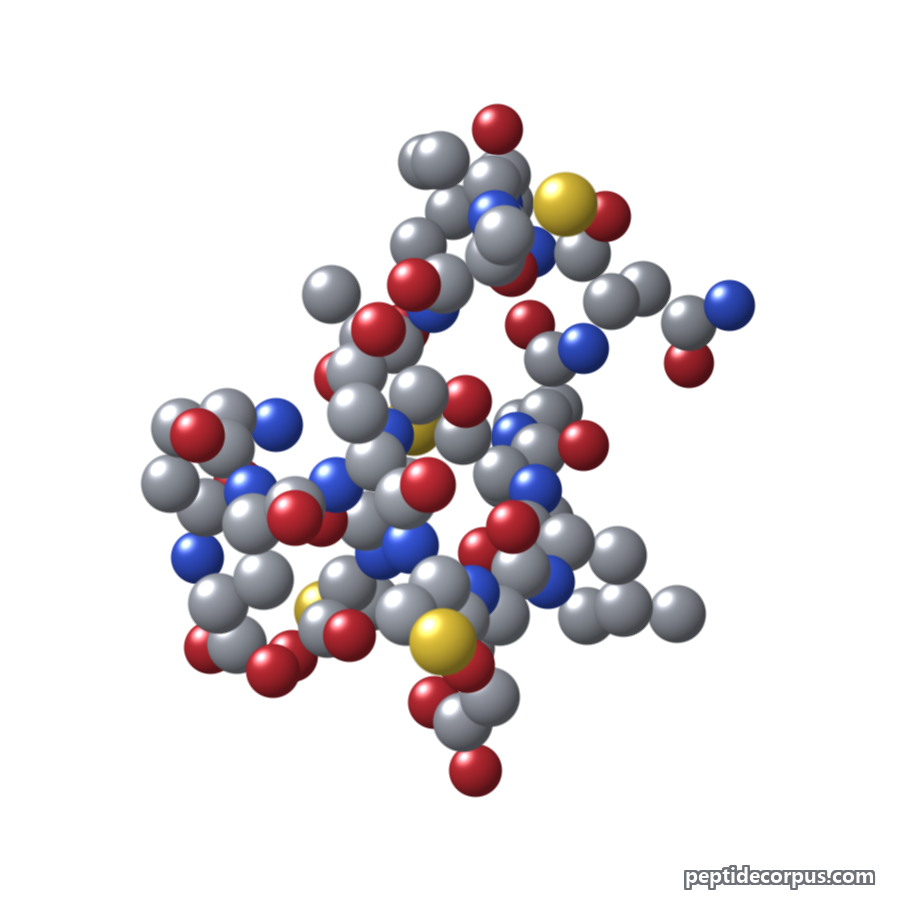
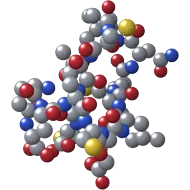
Skeletal formulathe canonical depiction
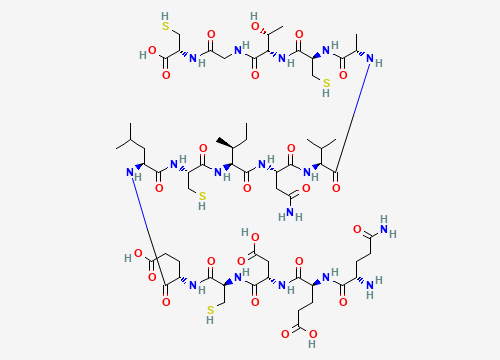
Drawn by PubChem from CID 5488765, the identifier on this record.
- Molecular weight
- 1600.8
- Molecular formula
- C61H101N17O25S4
- CAS number
- 152175-68-3
- PubChem CID
- 5488765
- InChI key
- SJMPVWVIVWEWJK-AXEIBBKLSA-N
- Sequence
- QEDCELCINVACTGC
- SMILES
- CC[C@H](C)[C@@H](C(=O)N[C@@H](CC(=O)N)C(=O)N[C@@H](C(C)C)C(=O)N[C@@H](C)C(=O)N[C@@H](CS)C(=O)N[C@@H]([C@@H](C)O)C(=O)NCC(=O)N[C@@H](CS)C(=O)O)NC(=O)[C@H](CS)NC(=O)[C@H](CC(C)C)NC(=O)[C@H](CCC(=O)O)NC(=O)[C@H](CS)NC(=O)[C@H](CC(=O)O)NC(=O)[C@H](CCC(=O)O)NC(=O)[C@H](CCC(=O)N)N
- InChI
- InChI=1S/C61H101N17O25S4/c1-9-26(6)46(60(101)72-33(17-40(64)81)54(95)76-45(25(4)5)59(100)66-27(7)48(89)73-36(21-105)57(98)78-47(28(8)79)58(99)65-19-41(82)67-38(23-107)61(102)103)77-56(97)37(22-106)75-52(93)32(16-24(2)3)70-51(92)31(12-15-43(85)86)69-55(96)35(20-104)74-53(94)34(18-44(87)88)71-50(91)30(11-14-42(83)84)68-49(90)29(62)10-13-39(63)80/h24-38,45-47,79,104-107H,9-23,62H2,1-8H3,(H2,63,80)(H2,64,81)(H,65,99)(H,66,100)(H,67,82)(H,68,90)(H,69,96)(H,70,92)(H,71,91)(H,72,101)(H,73,89)(H,74,94)(H,75,93)(H,76,95)(H,77,97)(H,78,98)(H,83,84)(H,85,86)(H,87,88)(H,102,103)/t26-,27-,28+,29-,30-,31-,32-,33-,34-,35-,36-,37-,38-,45-,46-,47-/m0/s1
Notes unverified prose
No FDA approval; preclinical; Phase II SP-304; observational studies only
Not on file 1
All 8 tracked fields hold a value on this record. 1 further absence is named below. A blank field is a bug; a named absence is a finding.
- half-lifenothing we hold supplies it
Each field links to every other record missing the same thing. The full ledger holds 765 gaps across 163 records.
Share this record