Gastrointestinal Health
Secretin
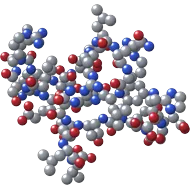
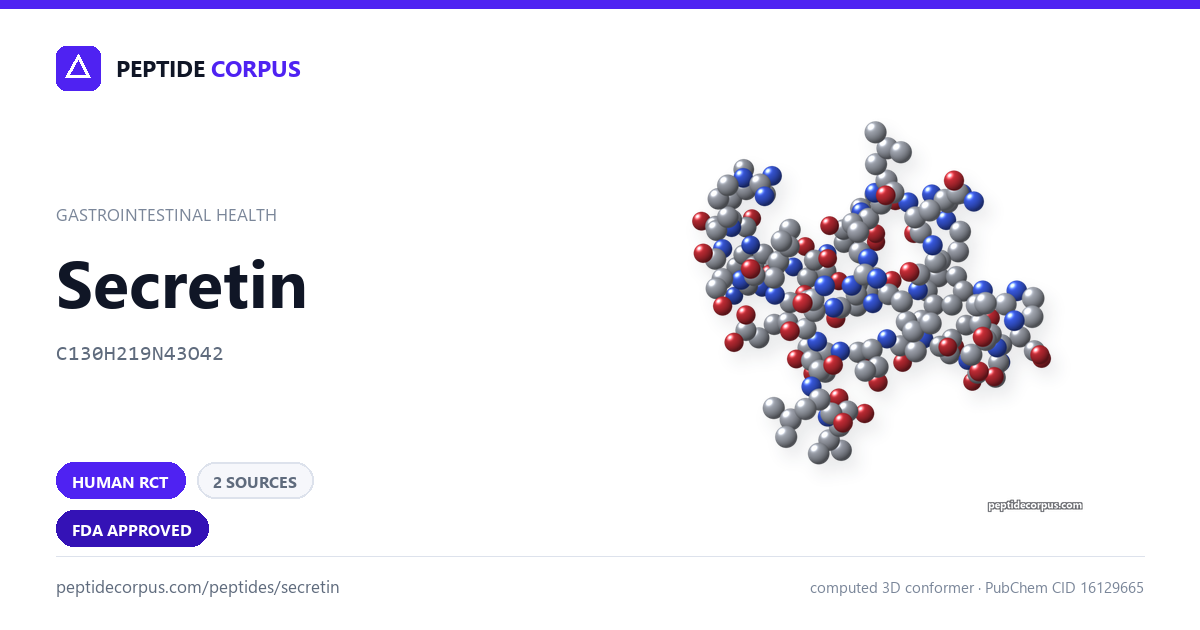
Secretin is what the upper small intestine says when stomach acid arrives: it tells the pancreas to flood the gut with bicarbonate and neutralise it. The indexed literature on it begins in 1903, which makes it one of the oldest entries in this corpus, and its place in medicine today is small and exact. Approved by the United States Food and Drug Administration as ChiRhoStim, it is injected for one purpose — to provoke the pancreas, or a suspected gastrin-producing tumour, into revealing itself during a test. It is a diagnostic agent rather than a treatment, and that distinction is the whole content of its licence.
Last updated
Mechanism
Stimulates pancreatic ductal cells to secrete bicarbonate-rich fluid, and provokes gastrin release in gastrinoma.
Regulatory status
Approved by the FDA. Marketed as CHIRHOSTIM, CHIRHOSTIM 40. Earliest approval 2004-04-09. Application NDA021256.
An approval grades as rung 1 on this site, because 21 CFR 314.126 requires adequate and well-controlled human investigations and one cannot be granted without them. It covers specific indications and doses, though, and does not transfer to other uses of the same molecule.
Reported effects
What sources associate with this compound. Reported categories, not outcomes we have graded — each would need its own citation and rung.
- Pancreatic function testing
- Gastrinoma diagnosis
- Secretin-enhanced MRCP imaging
Dosing on file unverified
Diagnostic: 0.2 mcg/kg IV over 1 min (pancreatic function); 0.4 mcg/kg IV over 1 min (gastrinoma)
Carried from a source that labels it unverified, and reproduced with that label attached. A record of what is reported, not a recommendation. No citation on this page establishes it.
Half-life, storage & sport
- Elimination half-life
- 45 minutes (human, IV) — study. CHIRHOSTIM FDA prescribing information, section 12.3.
The half-life on file is 45 min, measured intravenously. No dosing schedule could be read from this record, so the curve below is one dose drawn from the moment it is given. Nothing here says how often it is repeated.
The rise is not modelled and the axis is not a blood level. No absorption rate constant and no volume of distribution are on file, so each dose appears at full height the instant it is given, and the axis is percent of this compound's own peak.
Literature on file 3
-
human observational
Pancreatic duct: morphologic and functional evaluation with dynamic MR pancreatography after secretin stimulation (Radiology 1997, cited 323x) graded on: dynamic MR pancreatography in 10 healthy volunteers and 13 patients, non-randomised — read from the abstract — “abstract review”
-
animal in vivo
Molecular cloning and expression of a cDNA encoding the secretin receptor (The EMBO Journal 1991, cited 335x) graded on: an animal model — read from the indexed abstract — “rats”
-
human RCT
FDA approval NDA021256 graded on: an FDA approval (NDA021256), which requires adequate and well-controlled human investigations — “NDA021256”
Identity
Skeletal formulathe canonical depiction
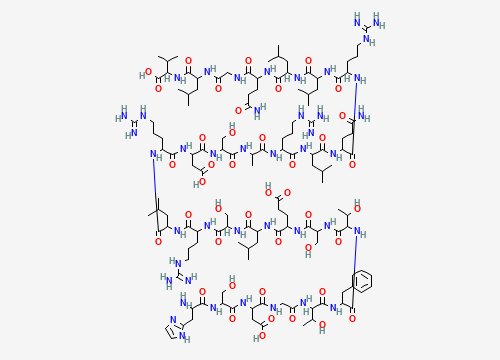
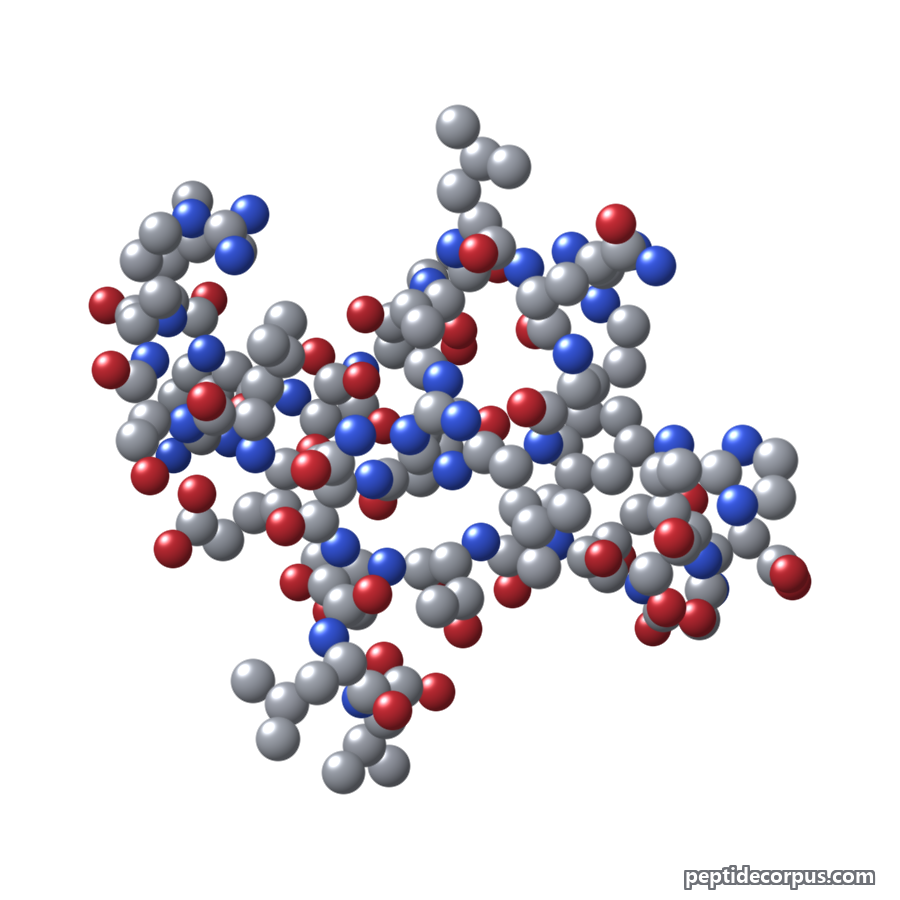
Drawn by PubChem from CID 16129665, the identifier on this record.
- Molecular weight
- 3056.4
- Molecular formula
- C130H219N43O42
- CAS number
- 1393-25-5
- PubChem CID
- 16129665
- UniProt
- P09683
- InChI key
- KKNIUBFRGPFELP-UHFFFAOYSA-N
- SMILES
- CC(C)CC(C(=O)NC(C(C)C)C(=O)O)NC(=O)CNC(=O)C(CCC(=O)N)NC(=O)C(CC(C)C)NC(=O)C(CC(C)C)NC(=O)C(CCCNC(=N)N)NC(=O)C(CCC(=O)N)NC(=O)C(CC(C)C)NC(=O)C(CCCNC(=N)N)NC(=O)C(C)NC(=O)C(CO)NC(=O)C(CC(=O)O)NC(=O)C(CCCNC(=N)N)NC(=O)C(CC(C)C)NC(=O)C(CCCNC(=N)N)NC(=O)C(CO)NC(=O)C(CC(C)C)NC(=O)C(CCC(=O)O)NC(=O)C(CO)NC(=O)C(C(C)O)NC(=O)C(CC1=CC=CC=C1)NC(=O)C(C(C)O)NC(=O)CNC(=O)C(CC(=O)O)NC(=O)C(CO)NC(=O)C(CC2=NC=CN2)N
- InChI
- InChI=1S/C130H219N43O42/c1-59(2)43-78(118(206)172-99(65(13)14)126(214)215)151-94(182)53-148-104(192)75(31-34-91(132)180)156-113(201)81(46-62(7)8)163-115(203)82(47-63(9)10)161-107(195)72(28-22-38-145-128(136)137)153-110(198)76(32-35-92(133)181)157-114(202)80(45-61(5)6)159-106(194)71(27-21-37-144-127(134)135)152-102(190)66(15)150-120(208)87(55-174)168-117(205)86(52-98(188)189)165-109(197)73(29-23-39-146-129(138)139)154-112(200)79(44-60(3)4)160-108(196)74(30-24-40-147-130(140)141)155-121(209)89(57-176)169-116(204)83(48-64(11)12)162-111(199)77(33-36-96(184)185)158-122(210)90(58-177)170-125(213)101(68(17)179)173-119(207)84(49-69-25-19-18-20-26-69)166-124(212)100(67(16)178)171-95(183)54-149-105(193)85(51-97(186)187)164-123(211)88(56-175)167-103(191)70(131)50-93-142-41-42-143-93/h18-20,25-26,41-42,59-68,70-90,99-101,174-179H,21-24,27-40,43-58,131H2,1-17H3,(H2,132,180)(H2,133,181)(H,142,143)(H,148,192)(H,149,193)(H,150,208)(H,151,182)(H,152,190)(H,153,198)(H,154,200)(H,155,209)(H,156,201)(H,157,202)(H,158,210)(H,159,194)(H,160,196)(H,161,195)(H,162,199)(H,163,203)(H,164,211)(H,165,197)(H,166,212)(H,167,191)(H,168,205)(H,169,204)(H,170,213)(H,171,183)(H,172,206)(H,173,207)(H,184,185)(H,186,187)(H,188,189)(H,214,215)(H4,134,135,144)(H4,136,137,145)(H4,138,139,146)(H4,140,141,147)
Notes unverified prose
FDA-approved (ChiRhoStim) 2004; diagnostic use only; FDA-approved (ChiRhoStim)
Not on file 1
1 of the 8 fields we track hold nothing on this record, and each says why. A blank field is a bug; a named absence is a finding.
- amino-acid sequencenothing we hold supplies it
Each field links to every other record missing the same thing. The full ledger holds 765 gaps across 163 records.
Share this record