Sleep, Mood & Stress
Sauvagine
Sauvagine is a forty-amino-acid peptide from frog skin that fits the human receptors for corticotropin-releasing factor, the hormone that begins the stress response. Because it activates both of those receptors strongly, it became a standard laboratory reagent: the reference stress-axis agonist that candidate blockers are tested against. That role is visible in its own citation list — in most of the papers attached to it, sauvagine is the tool and something else is the subject. It is not sold, and no person has been given it.
Last updated
Mechanism
Non-selective agonist at CRF1 and CRF2 receptors, stimulating cAMP and calcium signalling in stress and appetite pathways.
Reported effects
What sources associate with this compound. Reported categories, not outcomes we have graded — each would need its own citation and rung.
- Stress axis research
- CRF receptor pharmacology
- Appetite and gastric motility studies
Dosing on file unverified
No established human dose; preclinical only
Carried from a source that labels it unverified, and reproduced with that label attached. A record of what is reported, not a recommendation. No citation on this page establishes it.
Literature on file 6
-
review or editorial
Role of Peptides in Skeletal Muscle Wasting: A Scoping Review. graded on: indexed as "review-article" - secondary literature, not a study — “review-article”
-
animal in vivo
Pharmacological Characterization of the Novel CRF1 Receptor Antagonist, Thiazolo[4,5-d] Pyrimidine Analog, M43. graded on: an animal model — read from the indexed abstract — “mice”
-
computational
Design, Synthesis, and Biological Evaluations of Novel Thiazolo[4,5-d]pyrimidine Corticotropin Releasing Factor (CRF) Receptor Antagonists as Potential Treatments for Stress Related Disorders and Congenital Adrenal Hyperplasia (CAH). graded on: a computational prediction — read from the indexed abstract — “in silico”
-
animal in vivo
Corticotropin-releasing factor receptor agonists decrease interstitial cells of Cajal in murine colon. graded on: an animal model — “murine”
- in vitro
Not graded
1 citation whose study design could not be read from the title. Left ungraded rather than guessed at.
- not graded
Identity
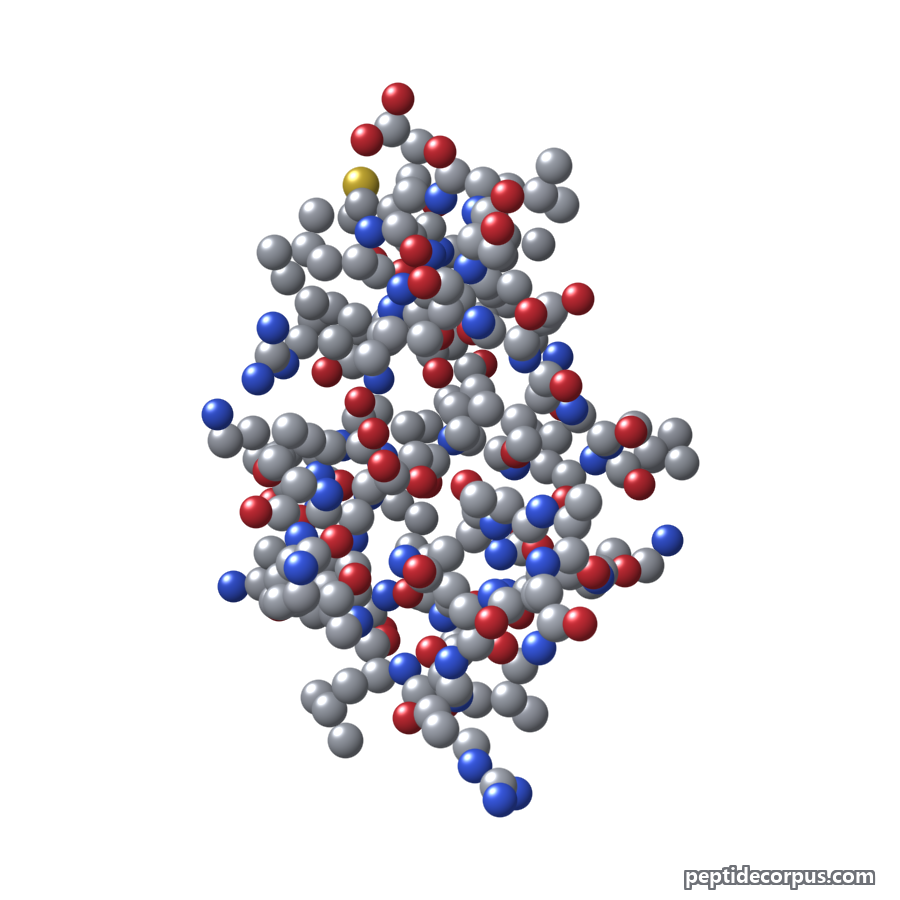
Skeletal formulathe canonical depiction
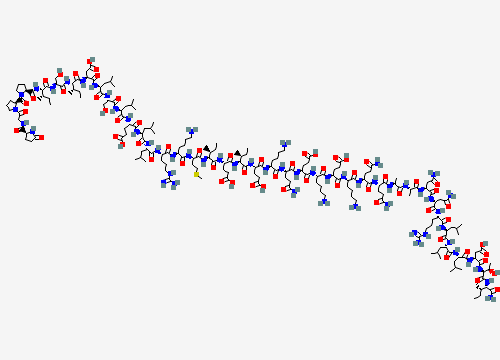
Drawn by PubChem from CID 16132335, the identifier on this record.
- Molecular weight
- 4599
- Molecular formula
- C202H346N56O63S
- CAS number
- 74434-59-6
- PubChem CID
- 16132335
- InChI key
- ILCVKEBXPLEGOY-ZLFMSJRASA-N
- SMILES
- CC[C@H](C)[C@@H](C(=O)N)NC(=O)[C@H]([C@@H](C)O)NC(=O)[C@H](CC(=O)O)NC(=O)[C@H](CC(C)C)NC(=O)[C@H](CC(C)C)NC(=O)[C@H](CC(C)C)NC(=O)[C@H](CCCNC(=N)N)NC(=O)[C@H](CC(=O)N)NC(=O)[C@H](CC(=O)N)NC(=O)[C@H](C)NC(=O)[C@H](C)NC(=O)[C@H](CCC(=O)N)NC(=O)[C@H](CCC(=O)N)NC(=O)[C@H](CCCCN)NC(=O)[C@H](CCC(=O)O)NC(=O)[C@H](CCCCN)NC(=O)[C@H](CCC(=O)O)NC(=O)[C@H](CCC(=O)N)NC(=O)[C@H](CCCCN)NC(=O)[C@H](CCC(=O)O)NC(=O)[C@H]([C@@H](C)CC)NC(=O)[C@H](CCC(=O)O)NC(=O)[C@H]([C@@H](C)CC)NC(=O)[C@H](CCSC)NC(=O)[C@H](CCCCN)NC(=O)[C@H](CCCNC(=N)N)NC(=O)[C@H](CC(C)C)NC(=O)[C@H](CC(C)C)NC(=O)[C@H](CCC(=O)O)NC(=O)[C@H](CC(C)C)NC(=O)[C@H](CO)NC(=O)[C@H](CC(C)C)NC(=O)[C@H](CC(=O)O)NC(=O)[C@H]([C@@H](C)CC)NC(=O)[C@H](CO)NC(=O)[C@H]([C@@H](C)CC)NC(=O)[C@@H]1CCCN1C(=O)[C@@H]2CCCN2C(=O)CNC(=O)[C@@H]3CCC(=O)N3
- InChI
- InChI=1S/C202H346N56O63S/c1-29-103(20)156(162(212)283)251-199(320)161(110(27)261)256-191(312)137(92-155(281)282)247-186(307)132(87-101(16)17)243-185(306)131(86-100(14)15)242-183(304)129(84-98(10)11)239-172(293)116(51-43-78-218-202(215)216)228-188(309)135(90-146(211)266)246-189(310)134(89-145(210)265)238-164(285)109(26)220-163(284)108(25)221-166(287)118(54-63-142(207)262)229-173(294)119(55-64-143(208)263)230-167(288)111(46-34-38-73-203)224-175(296)121(58-67-149(269)270)232-169(290)113(48-36-40-75-205)225-176(297)122(59-68-150(271)272)233-174(295)120(56-65-144(209)264)231-168(289)112(47-35-39-74-204)226-177(298)124(61-70-152(275)276)236-195(316)157(104(21)30-2)252-179(300)125(62-71-153(277)278)237-196(317)158(105(22)31-3)253-180(301)126(72-81-322-28)235-170(291)114(49-37-41-76-206)223-171(292)115(50-42-77-217-201(213)214)227-181(302)127(82-96(6)7)241-184(305)130(85-99(12)13)240-178(299)123(60-69-151(273)274)234-182(303)128(83-97(8)9)245-192(313)138(94-259)249-187(308)133(88-102(18)19)244-190(311)136(91-154(279)280)248-197(318)159(106(23)32-4)254-193(314)139(95-260)250-198(319)160(107(24)33-5)255-194(315)140-52-44-80-258(140)200(321)141-53-45-79-257(141)148(268)93-219-165(286)117-57-66-147(267)222-117/h96-141,156-161,259-261H,29-95,203-206H2,1-28H3,(H2,207,262)(H2,208,263)(H2,209,264)(H2,210,265)(H2,211,266)(H2,212,283)(H,219,286)(H,220,284)(H,221,287)(H,222,267)(H,223,292)(H,224,296)(H,225,297)(H,226,298)(H,227,302)(H,228,309)(H,229,294)(H,230,288)(H,231,289)(H,232,290)(H,233,295)(H,234,303)(H,235,291)(H,236,316)(H,237,317)(H,238,285)(H,239,293)(H,240,299)(H,241,305)(H,242,304)(H,243,306)(H,244,311)(H,245,313)(H,246,310)(H,247,307)(H,248,318)(H,249,308)(H,250,319)(H,251,320)(H,252,300)(H,253,301)(H,254,314)(H,255,315)(H,256,312)(H,269,270)(H,271,272)(H,273,274)(H,275,276)(H,277,278)(H,279,280)(H,281,282)(H4,213,214,217)(H4,215,216,218)/t103-,104-,105-,106-,107-,108-,109-,110+,111-,112-,113-,114-,115-,116-,117-,118-,119-,120-,121-,122-,123-,124-,125-,126-,127-,128-,129-,130-,131-,132-,133-,134-,135-,136-,137-,138-,139-,140-,141-,156-,157-,158-,159-,160-,161-/m0/s1
Notes unverified prose
No human clinical trials identified; preclinical only; No human clinical trials
Not on file 3
1 of the 8 fields we track hold nothing on this record, and each says why. 2 further absences are named below. A blank field is a bug; a named absence is a finding.
- amino-acid sequencenothing we hold supplies it
- half-lifenothing we hold supplies it
- route of administrationnothing we hold supplies it
Each field links to every other record missing the same thing. The full ledger holds 765 gaps across 163 records.
Share this record