Miscellaneous & Research; Cognitive & Neuroprotection
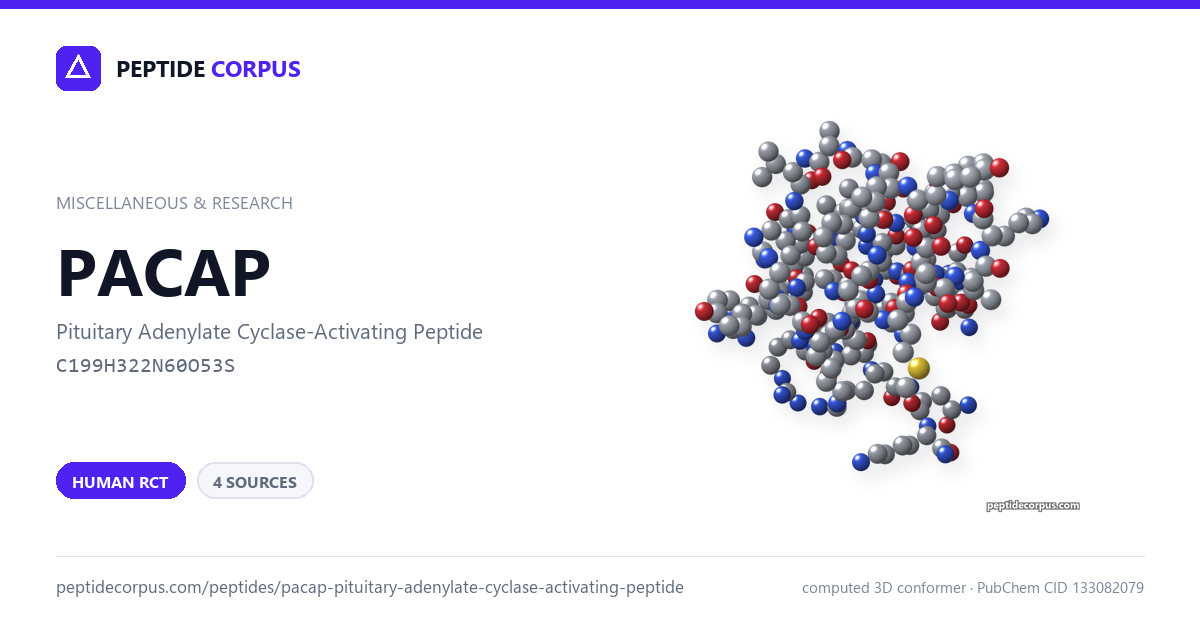
PACAP (Pituitary Adenylate Cyclase-Activating Peptide)
Infuse PACAP — pituitary adenylate cyclase-activating peptide — into someone prone to migraine and an attack follows. In randomised, placebo-controlled crossover trials, PACAP-38 provoked migraine-like attacks in 7 of 12 patients and none on placebo, and the shorter PACAP-27 in 11 of 20 against 2 on placebo. That reliability is what makes it one of the more credible targets in headache research, and why the drug development here runs backwards from the rest of this corpus: the aim is to block PACAP, not to supply it. A Phase 2 trial of an antibody against the peptide is on file, and there is no use of PACAP itself as a treatment.
Last updated
Mechanism
Activates PAC1, VPAC1, and VPAC2 receptors, raising cyclic AMP, dilating dural vessels, and exciting trigeminovascular nociception.
Reported effects
What sources associate with this compound. Reported categories, not outcomes we have graded — each would need its own citation and rung.
- Migraine mechanism research
- Antibody target research
- Neuroprotection research
Dosing on file unverified
PACAP-38: migraine induction studies; Monoclonal antibodies: Phase 2 (LY3451838 1,500 mg IV, Lu AG09222); Monoclonal antibodies: LY3451838 1,500 mg IV single dose (Phase 2); Lu AG09222 Phase 2
Carried from a source that labels it unverified, and reproduced with that label attached. A record of what is reported, not a recommendation. No citation on this page establishes it.
Literature on file 4
-
human RCT
NCT05133323: Interventional, Randomized, Double-blind, Parallel-group, Placebo-controlled Study of Lu AG09222 for the Prevention of Migraine in Patients With Unsuccessful Prior Preventive Treatments graded on: randomised and placebo-controlled — “Randomized, Double-blind, Parallel-group, Placebo-controlled”
-
animal in vivo
Differential signal transduction by five splice variants of the PACAP receptor (Nature 1993, cited 996x) graded on: an animal model — read from the indexed abstract — “rats”
-
animal in vivo
Post-traumatic stress disorder is associated with PACAP and the PAC1 receptor (Nature 2011, cited 727x) graded on: an animal model — read from the indexed abstract — “rats”
Not graded
1 citation whose study design could not be read from the title. Left ungraded rather than guessed at.
-
not graded
NCT07342296: Induction of Migraine Attacks With Aura Using Pituitary Adenylate Cyclase Activating Polypeptide-38: A Randomized Clinical Trial graded on: NCT07342296 is not yet recruiting and has posted no results - a registration, not a reported outcome — “NCT07342296”
Identity
Skeletal formulathe canonical depiction
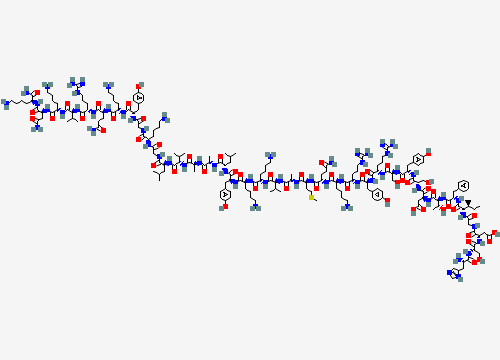
Drawn by PubChem from CID 133082079, the identifier on this record.
- Molecular weight
- 4435
- Molecular formula
- C199H322N60O53S
- CAS number
- 137061-48-4
- PubChem CID
- 133082079
- UniProt
- P18509 (precursor)
- InChI key
- SIOKKMOWMDCVKB-RGBLINGASA-N
- SMILES
- CC[C@H](C)[C@@H](C(=O)N[C@@H](CC1=CC=CC=C1)C(=O)N[C@@H]([C@@H](C)O)C(=O)N[C@@H](CC(=O)O)C(=O)N[C@@H](CO)C(=O)N[C@@H](CC2=CC=C(C=C2)O)C(=O)N[C@@H](CO)C(=O)N[C@@H](CCCNC(=N)N)C(=O)N[C@@H](CC3=CC=C(C=C3)O)C(=O)N[C@@H](CCCNC(=N)N)C(=O)N[C@@H](CCCCN)C(=O)N[C@@H](CCC(=O)N)C(=O)N[C@@H](CCSC)C(=O)N[C@@H](C)C(=O)N[C@@H](C(C)C)C(=O)N[C@@H](CCCCN)C(=O)N[C@@H](CCCCN)C(=O)N[C@@H](CC4=CC=C(C=C4)O)C(=O)N[C@@H](CC(C)C)C(=O)N[C@@H](C)C(=O)N[C@@H](C)C(=O)N[C@@H](C(C)C)C(=O)N[C@@H](CC(C)C)C(=O)NCC(=O)N[C@@H](CCCCN)C(=O)NCC(=O)N[C@@H](CC5=CC=C(C=C5)O)C(=O)N[C@@H](CCCCN)C(=O)N[C@@H](CCC(=O)N)C(=O)N[C@@H](CCCNC(=N)N)C(=O)N[C@@H](C(C)C)C(=O)N[C@@H](CCCCN)C(=O)N[C@@H](CC(=O)N)C(=O)N[C@@H](CCCCN)C(=O)N)NC(=O)CNC(=O)[C@H](CC(=O)O)NC(=O)[C@H](CO)NC(=O)[C@H](CC6=CN=CN6)N
- InChI
- InChI=1S/C199H322N60O53S/c1-18-107(12)160(255-154(273)97-224-169(285)144(92-155(274)275)248-190(306)146(98-260)252-166(282)122(207)90-117-94-218-101-225-117)195(311)250-142(85-112-39-20-19-21-40-112)188(304)259-161(111(16)263)196(312)251-145(93-156(276)277)187(303)254-148(100-262)191(307)246-141(89-116-57-65-121(267)66-58-116)185(301)253-147(99-261)189(305)237-131(49-37-80-220-198(214)215)177(293)244-139(87-114-53-61-119(265)62-54-114)183(299)236-130(48-36-79-219-197(212)213)174(290)232-125(43-24-31-74-202)171(287)239-134(68-70-150(209)269)179(295)240-135(71-82-313-17)170(286)227-110(15)165(281)256-157(104(6)7)192(308)241-128(46-27-34-77-205)173(289)233-127(45-26-33-76-204)175(291)245-140(88-115-55-63-120(266)64-56-115)184(300)243-137(84-103(4)5)181(297)228-108(13)163(279)226-109(14)164(280)257-158(105(8)9)194(310)249-136(83-102(2)3)168(284)223-95-152(271)229-124(42-23-30-73-201)167(283)222-96-153(272)230-138(86-113-51-59-118(264)60-52-113)182(298)235-126(44-25-32-75-203)172(288)238-133(67-69-149(208)268)178(294)234-132(50-38-81-221-199(216)217)180(296)258-159(106(10)11)193(309)242-129(47-28-35-78-206)176(292)247-143(91-151(210)270)186(302)231-123(162(211)278)41-22-29-72-200/h19-21,39-40,51-66,94,101-111,122-148,157-161,260-267H,18,22-38,41-50,67-93,95-100,200-207H2,1-17H3,(H2,208,268)(H2,209,269)(H2,210,270)(H2,211,278)(H,218,225)(H,222,283)(H,223,284)(H,224,285)(H,226,279)(H,227,286)(H,228,297)(H,229,271)(H,230,272)(H,231,302)(H,232,290)(H,233,289)(H,234,294)(H,235,298)(H,236,299)(H,237,305)(H,238,288)(H,239,287)(H,240,295)(H,241,308)(H,242,309)(H,243,300)(H,244,293)(H,245,291)(H,246,307)(H,247,292)(H,248,306)(H,249,310)(H,250,311)(H,251,312)(H,252,282)(H,253,301)(H,254,303)(H,255,273)(H,256,281)(H,257,280)(H,258,296)(H,259,304)(H,274,275)(H,276,277)(H4,212,213,219)(H4,214,215,220)(H4,216,217,221)/t107-,108-,109-,110-,111+,122-,123-,124-,125-,126-,127-,128-,129-,130-,131-,132-,133-,134-,135-,136-,137-,138-,139-,140-,141-,142-,143-,144-,145-,146-,147-,148-,157-,158-,159-,160-,161-/m0/s1
Also called
- PACAP
- PACAP (Research)
Caveat on these identifiers
NCT05133323 tests an ANTI-PACAP antibody (Lu AG09222), not PACAP administration. Source files disagreed on evidence tier for this peptide.
Notes unverified prose
NCT07342296; Phase 2 HOPE trial (NCT05133323); NCT07342296 (PACAP-38 migraine induction); LY3451838 1,500 mg IV for migraine; Phase 2 HOPE trial (Lu AG09222); LY3451838 Phase 1/2
Not on file 2
1 of the 8 fields we track hold nothing on this record, and each says why. 1 further absence is named below. A blank field is a bug; a named absence is a finding.
- amino-acid sequencenothing we hold supplies it
- half-lifenothing we hold supplies it
Each field links to every other record missing the same thing. The full ledger holds 765 gaps across 163 records.
Share this record