Sleep, Mood & Stress
Neuropeptide Y
Neuropeptide Y is among the most abundant peptides in the brain and in the sympathetic nervous system, and the reason it is discussed is stress resilience: it is studied as the body's own brake on its own stress response. Its receptors pull against each other, which is part of what makes it hard to use — activating the Y1 subtype calms, activating Y2 does the reverse. Human testing so far is one Phase Ib trial in which 26 people with post-traumatic stress disorder received a single intranasal dose during a trauma-recall session; anxiety scores fell at the higher doses, two of the three measures reached non-significant trends, and what a repeated course would do has not been tested.
Last updated
Mechanism
Acts at Y1 to Y5 G-protein-coupled receptors; Y1 activation is anxiolytic while Y2 activation is anxiogenic.
Reported effects
What sources associate with this compound. Reported categories, not outcomes we have graded — each would need its own citation and rung.
- Stress resilience research
- PTSD symptom research
- Appetite regulation context
Dosing on file unverified
Single dose: 1.4-9.6 mg intranasal (dose escalation)
Carried from a source that labels it unverified, and reproduced with that label attached. A record of what is reported, not a recommendation. No citation on this page establishes it.
Literature on file 3
-
animal in vivo
Neuropeptide Y-a novel brain peptide with structural similarities to peptide YY and pancreatic polypeptide (Nature 1982, cited 1911x) graded on: an animal model — read from the indexed abstract — “swine”
-
animal in vivo
The role of neuropeptide Y in the antiobesity action of the obese gene product (Nature 1995, cited 1105x) graded on: an animal model — read from the indexed abstract — “rats”
Not graded
1 citation whose study design could not be read from the title. Left ungraded rather than guessed at.
-
not graded
NCT04071600: Intranasal Neuropeptide Y in Clinical Trial in Level Two Trauma Patients for PTSD and Acute Stress Disorder (ASD) graded on: NCT04071600 is unknown and has posted no results - a registration, not a reported outcome — “NCT04071600”
Identity
Skeletal formulathe canonical depiction
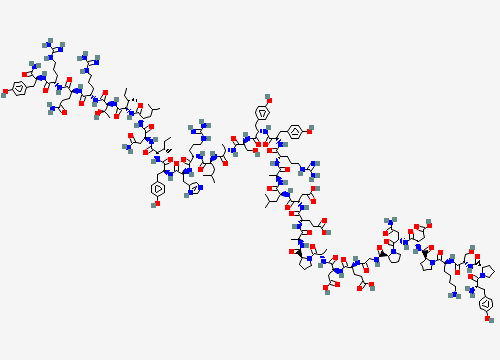
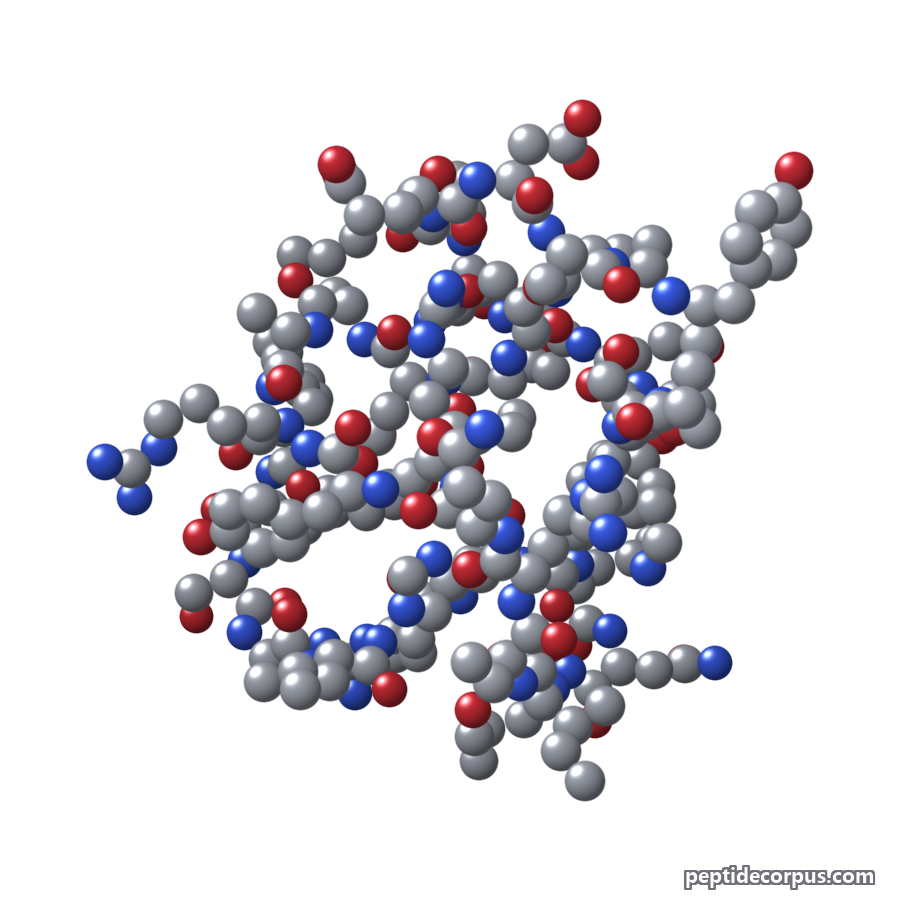
Drawn by PubChem from CID 16132350, the identifier on this record.
- Molecular weight
- 4254
- Molecular formula
- C190H287N55O57
- CAS number
- 82785-45-3
- PubChem CID
- 16132350
- UniProt
- P01303 (precursor)
- InChI key
- URPYMXQQVHTUDU-OFGSCBOVSA-N
- SMILES
- CC[C@H](C)[C@@H](C(=O)N[C@@H](CC(=O)N)C(=O)N[C@@H](CC(C)C)C(=O)N[C@@H]([C@@H](C)CC)C(=O)N[C@@H]([C@@H](C)O)C(=O)N[C@@H](CCCNC(=N)N)C(=O)N[C@@H](CCC(=O)N)C(=O)N[C@@H](CCCNC(=N)N)C(=O)N[C@@H](CC1=CC=C(C=C1)O)C(=O)N)NC(=O)[C@H](CC2=CC=C(C=C2)O)NC(=O)[C@H](CC3=CN=CN3)NC(=O)[C@H](CCCNC(=N)N)NC(=O)[C@H](CC(C)C)NC(=O)[C@H](C)NC(=O)[C@H](CO)NC(=O)[C@H](CC4=CC=C(C=C4)O)NC(=O)[C@H](CC5=CC=C(C=C5)O)NC(=O)[C@H](CCCNC(=N)N)NC(=O)[C@H](C)NC(=O)[C@H](CC(C)C)NC(=O)[C@H](CC(=O)O)NC(=O)[C@H](CCC(=O)O)NC(=O)[C@H](C)NC(=O)[C@@H]6CCCN6C(=O)[C@H](C)NC(=O)[C@H](CC(=O)O)NC(=O)[C@H](CCC(=O)O)NC(=O)CNC(=O)[C@@H]7CCCN7C(=O)[C@H](CC(=O)N)NC(=O)[C@H](CC(=O)O)NC(=O)[C@@H]8CCCN8C(=O)[C@H](CCCCN)NC(=O)[C@H](CO)NC(=O)[C@@H]9CCCN9C(=O)[C@H](CC1=CC=C(C=C1)O)N
- InChI
- InChI=1S/C190H287N55O57/c1-16-94(9)149(180(296)235-129(81-141(194)255)169(285)227-124(74-93(7)8)172(288)240-150(95(10)17-2)181(297)241-151(100(15)248)182(298)222-116(32-23-67-209-190(203)204)156(272)221-118(57-60-140(193)254)161(277)219-114(30-21-65-207-188(199)200)157(273)224-121(152(196)268)76-102-39-49-108(250)50-40-102)239-173(289)127(79-105-45-55-111(253)56-46-105)230-168(284)128(80-106-86-205-90-211-106)231-159(275)115(31-22-66-208-189(201)202)220-165(281)123(73-92(5)6)225-155(271)97(12)213-174(290)134(88-246)237-167(283)126(78-104-43-53-110(252)54-44-104)229-166(282)125(77-103-41-51-109(251)52-42-103)228-158(274)113(29-20-64-206-187(197)198)217-153(269)96(11)212-163(279)122(72-91(3)4)226-170(286)131(84-147(264)265)233-162(278)119(59-62-145(260)261)218-154(270)98(13)214-177(293)137-34-25-68-242(137)183(299)99(14)215-164(280)130(83-146(262)263)232-160(276)117(58-61-144(258)259)216-143(257)87-210-176(292)136-33-24-70-244(136)186(302)133(82-142(195)256)236-171(287)132(85-148(266)267)234-178(294)139-36-27-71-245(139)185(301)120(28-18-19-63-191)223-175(291)135(89-247)238-179(295)138-35-26-69-243(138)184(300)112(192)75-101-37-47-107(249)48-38-101/h37-56,86,90-100,112-139,149-151,246-253H,16-36,57-85,87-89,191-192H2,1-15H3,(H2,193,254)(H2,194,255)(H2,195,256)(H2,196,268)(H,205,211)(H,210,292)(H,212,279)(H,213,290)(H,214,293)(H,215,280)(H,216,257)(H,217,269)(H,218,270)(H,219,277)(H,220,281)(H,221,272)(H,222,298)(H,223,291)(H,224,273)(H,225,271)(H,226,286)(H,227,285)(H,228,274)(H,229,282)(H,230,284)(H,231,275)(H,232,276)(H,233,278)(H,234,294)(H,235,296)(H,236,287)(H,237,283)(H,238,295)(H,239,289)(H,240,288)(H,241,297)(H,258,259)(H,260,261)(H,262,263)(H,264,265)(H,266,267)(H4,197,198,206)(H4,199,200,207)(H4,201,202,208)(H4,203,204,209)/t94-,95-,96-,97-,98-,99-,100+,112-,113-,114-,115-,116-,117-,118-,119-,120-,121-,122-,123-,124-,125-,126-,127-,128-,129-,130-,131-,132-,133-,134-,135-,136-,137-,138-,139-,149-,150-,151-/m0/s1
Notes unverified prose
PTSD trial: well tolerated up to 9.6 mg; NCT04071600 intranasal dose escalation; PTSD trial (up to 9.6 mg intranasal); NCT04071600
Not on file 2
1 of the 8 fields we track hold nothing on this record, and each says why. 1 further absence is named below. A blank field is a bug; a named absence is a finding.
- amino-acid sequencenothing we hold supplies it
- half-lifenothing we hold supplies it
Each field links to every other record missing the same thing. The full ledger holds 765 gaps across 163 records.
Share this record