Tissue Repair & Regeneration
Myristoyl Pentapeptide-17
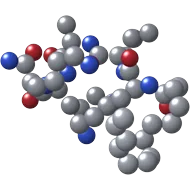
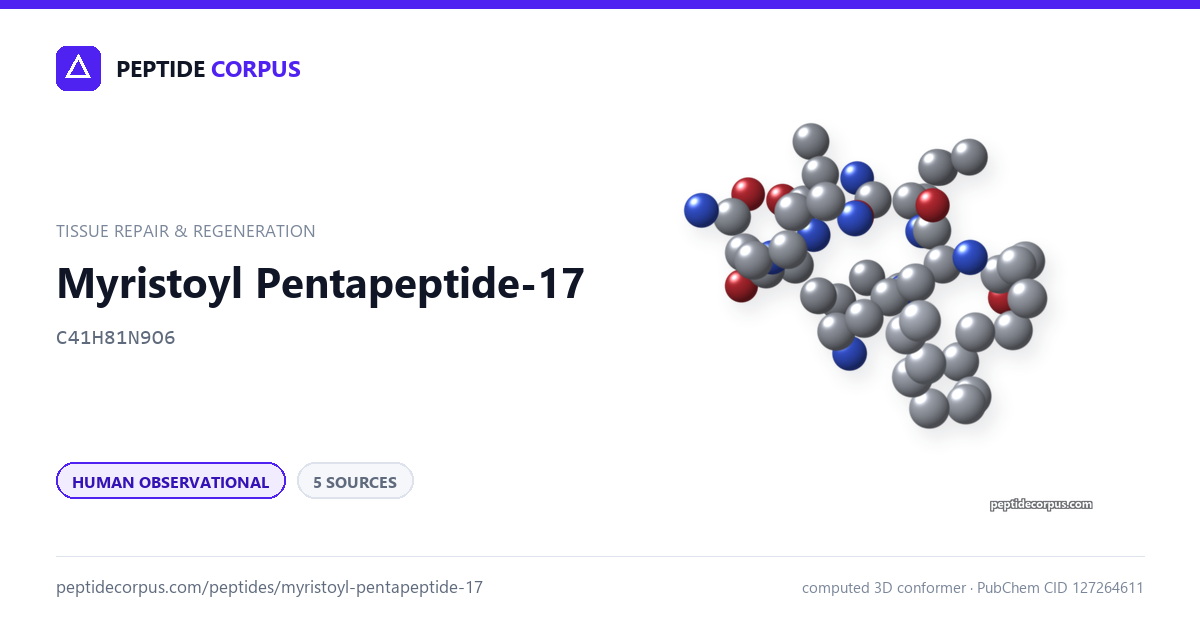
Myristoyl pentapeptide-17 is a five-amino-acid chain carrying a myristoyl group, a fourteen-carbon fatty tail, and that tail is the point: it is what lets a water-loving peptide cross into an oily follicle. It is the active ingredient in most over-the-counter lash and brow serums, sold on the claim that it drives follicle cells to make more keratin — a mechanism that comes from supplier literature rather than from published research. Every human study on file is open-label and tested a finished multi-ingredient serum, including a 90-day study in 30 women. The 41 per cent lash-density figure quoted everywhere has no readable trial behind it in this record.
Last updated
Mechanism
Supplier data describe stimulation of keratin gene expression in the follicle; independent peer-reviewed mechanistic evidence is limited.
Reported effects
What sources associate with this compound. Reported categories, not outcomes we have graded — each would need its own citation and rung.
- Lash conditioning research
- Brow cosmetic use
- Keratin expression context
Manufacturer’s claim vendor marketing
For a proprietary cosmetic ingredient the manufacturer is the originator — there is no upstream to defer to, and this is often the only description that exists. It is reproduced as an attributed claim, with the label its source gave it. It is not graded and it is not evidence — the graded studies are under Literature.
Vendor claims quoted from fetched page: "specifically designed to condition and strengthen eyelashes and eyebrows"; "promote the appearance of longer, thicker, and healthier-looking lashes and brows". SpecialChem page contains no clinical study data (no n=, no duration).
- Manufacturer
- Flychem / GfN-Selco / Shenzhen Winkey Technology (per SpecialChem); no original branded eyelash active (e.g. Symrise SymPeptide) confirmed on fetched pages
- Sold as
- MyriLash (Flychem); SpecPed MP 17P (GfN-Selco); WKPep Pro-Lash (Shenzhen Winkey Technology)
- Manufacturer’s recommended use
- Vendor claim: "0.001-0.1%"
Source page — nofollow, because a vendor link is a reference here, not an endorsement.
Dosing on file unverified
0.01-0.2% in serums/creams; 100 ppm (eyelash)
Carried from a source that labels it unverified, and reproduced with that label attached. A record of what is reported, not a recommendation. No citation on this page establishes it.
What is circulated about this dose. One claim is recorded on this page with the page it was read from. Read what is circulated.
Literature on file 5
-
human observational
TFOS Lifestyle: Impact of cosmetics on the ocular surface. graded on: a synthesis of human studies — the indexed publication type — “Systematic Review”
-
review or editorial
Review of applications of microneedling in dermatology. graded on: indexed as "review-article" - secondary literature, not a study — “review-article”
-
human observational
Evaluation of the Safety and Tolerability of Lumify Eye Illuminations Cosmetic Products. graded on: cumulative irritation test (n=34) and repeated insult patch test (n=201) plus uncontrolled use studies — read from the abstract — “abstract review”
-
human observational
An Open-label, Single-center, Safety and Efficacy Study of Eyelash Polygrowth Factor Serum. graded on: 90-day open-label single-centre study, 30 women, within-subject baseline — read from the abstract — “abstract review”
-
human observational
Effects of a New Topical Treatment Containing Several Hair Growth Promoters in Women with Early Female Pattern Hair Loss. graded on: open-label study of 49 women with early female pattern hair loss, no control arm — read from the abstract — “abstract review”
What is circulated not evidence 3
Claims passed around in community guides and vendor copy, recorded because they circulate — not because they are true. Each is shown with the page it was read from and what this record actually holds. Checked 2026-08-24.
-
It is circulated that a 2010 placebo-compared cosmetic study showed measurable increases in lash length, thickness and density, restated on retail pages as the peptide with "the strongest data".
Participants saw measurable increases in lash length, thickness, and density compared to a placebo group.
On the record The corpus summary states supplier data describe keratin gene stimulation and that independent peer-reviewed mechanistic evidence is limited. No lash-length trial result is on file; the retail page gives no effect size, no author and no confirmation of independence from the supplier — the brochure-to-retail restatement pattern.
-
A mechanism — extending the anagen phase of the lash cycle via keratin gene stimulation — circulates as established.
By stimulating activity in this area, the peptide extends the anagen (growth) phase of the lash cycle.
On the record The corpus mechanism row attributes the keratin-expression description to supplier data explicitly. No independent demonstration of anagen extension is on file.
-
A results timeline — initial improvement at weeks 4-6, peak at weeks 8-12 — circulates as an expectation.
Most users see initial improvement around week 4-6, with peak results at week 8-12.
On the record Nothing on file. The corpus holds no timeline data for this ingredient.
Identity
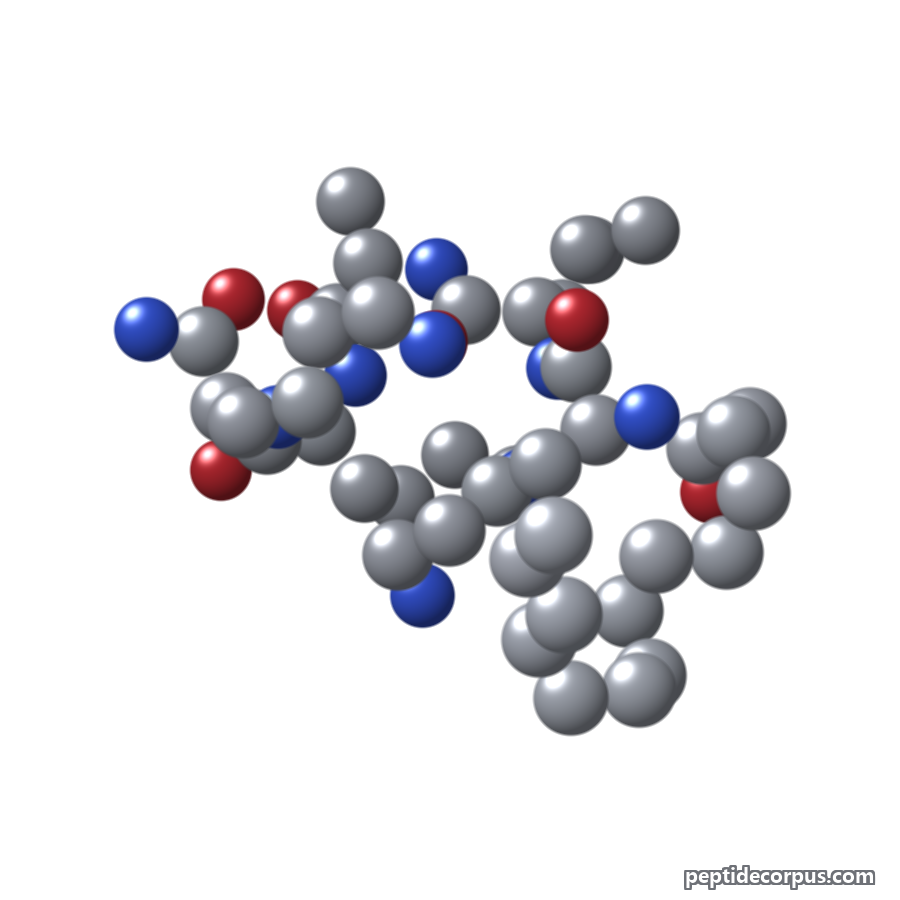
Skeletal formulathe canonical depiction
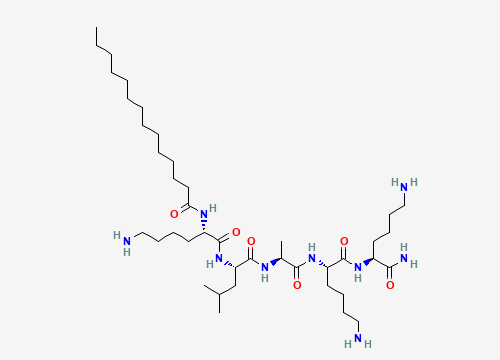
Drawn by PubChem from CID 127264611, the identifier on this record.
- Molecular weight
- 796.1
- Molecular formula
- C41H81N9O6
- CAS number
- 959610-30-1
- PubChem CID
- 127264611
- InChI key
- NFPWMUOQSJXGGZ-ZZTWKDBPSA-N
- SMILES
- CCCCCCCCCCCCCC(=O)N[C@@H](CCCCN)C(=O)N[C@@H](CC(C)C)C(=O)N[C@@H](C)C(=O)N[C@@H](CCCCN)C(=O)N[C@@H](CCCCN)C(=O)N
- InChI
- InChI=1S/C41H81N9O6/c1-5-6-7-8-9-10-11-12-13-14-15-25-36(51)47-33(23-17-20-27-43)39(54)50-35(29-30(2)3)41(56)46-31(4)38(53)49-34(24-18-21-28-44)40(55)48-32(37(45)52)22-16-19-26-42/h30-35H,5-29,42-44H2,1-4H3,(H2,45,52)(H,46,56)(H,47,51)(H,48,55)(H,49,53)(H,50,54)/t31-,32-,33-,34-,35-/m0/s1
Also called
- MyriLash
- Myristoyl Pentapeptide-17
- SpecPed MP 17P
- WKPep Pro-Lash
Notes unverified prose
DB RCT (n=120, 0.2%, 8 weeks): eyelash density +41.2%, length +38.5%; open-label 90-day: length +10.5%; Double-blind RCT (n=120, 0.2%, 8 weeks): 41.2% density, 38.5% length
Not on file 2
1 of the 8 fields we track hold nothing on this record, and each says why. 1 further absence is named below. A blank field is a bug; a named absence is a finding.
- amino-acid sequencenothing we hold supplies it
- half-lifenothing we hold supplies it
Each field links to every other record missing the same thing. The full ledger holds 765 gaps across 163 records.
Share this record