Immune & Antimicrobial
Melittin
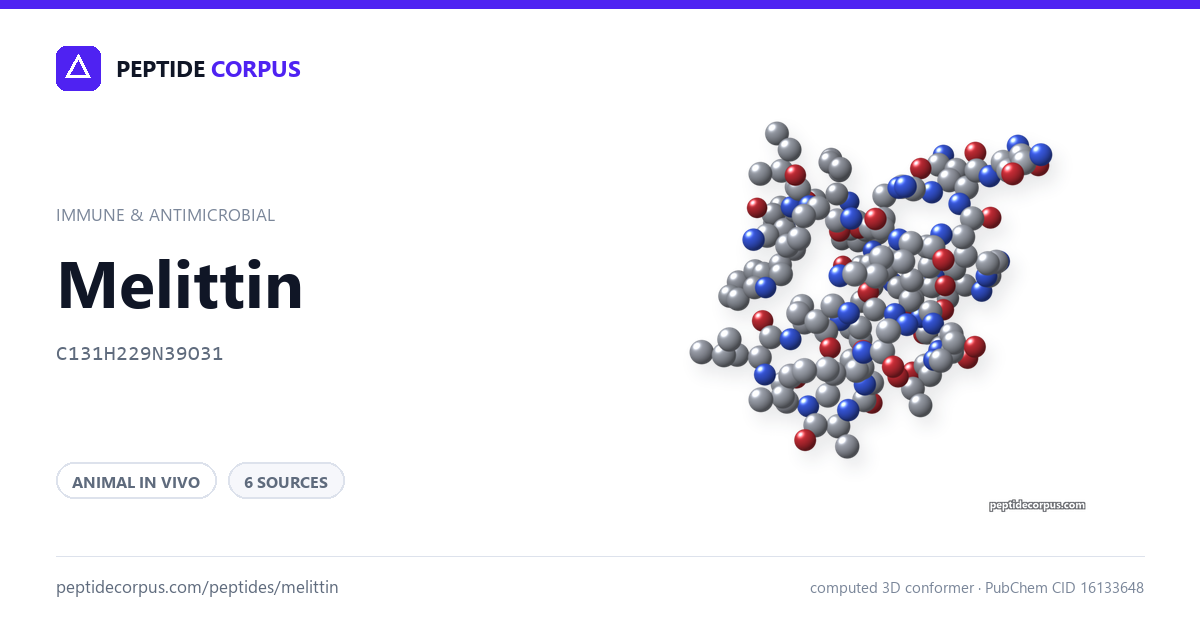
Melittin is what a bee sting feels like — the main peptide of honeybee venom, and the reason the pain arrives instantly. It destroys cell membranes on contact, which in a test tube makes it a formidable killer of the organisms that defeat antibiotics: extensively drug-resistant Acinetobacter, methicillin-resistant Staphylococcus aureus (MRSA) and carbapenemase-producing Klebsiella all fall at 8 to 32 micrograms per millilitre. Half of human red blood cells burst at 0.44. Those two numbers are the whole field in miniature: in infected mice, repeated dosing at the highest survivable level changed neither survival nor bacterial load while colistin and vancomycin did, because the concentration that kills the bacteria cannot be reached inside a living body.
Last updated
Mechanism
Amphipathic cationic helix that binds and permeabilises lipid bilayers, forming pores and potentiating phospholipase A2 activity.
Reported effects
What sources associate with this compound. Reported categories, not outcomes we have graded — each would need its own citation and rung.
- Antimicrobial research
- Cytotoxicity and oncology research
- Membrane pore-forming context
Dosing on file unverified
Topical Phase I (IRCT20190924044863N1); No established systemic dose
Carried from a source that labels it unverified, and reproduced with that label attached. A record of what is reported, not a recommendation. No citation on this page establishes it.
Literature on file 6
-
review or editorial
Multidimensional Modification and Functional Optimization of Melittin: From Natural Toxic Peptide to Safe and Effective Therapeutics. graded on: indexed as "Review" - secondary literature, not a study — “Review”
-
computational
Optimizing separation conditions for melittin purification from bee venom using molecular dynamics simulations. graded on: a computational prediction — “molecular dynamics”
-
animal in vivo
Melittin attenuates imiquimod-induced psoriatic dermatitis in mice: a role for autophagy activation via PI3K/Akt/mTOR pathway suppression. graded on: an animal model — “mice”
-
animal in vivo
Antimicrobial peptides from arthropod venoms exhibit activity against Sporothrix species. graded on: an animal model — read from the indexed abstract — “murine”
Not graded
2 citations whose study design could not be read from the title. Left ungraded rather than guessed at.
- not graded
- not graded
Identity
Skeletal formulathe canonical depiction
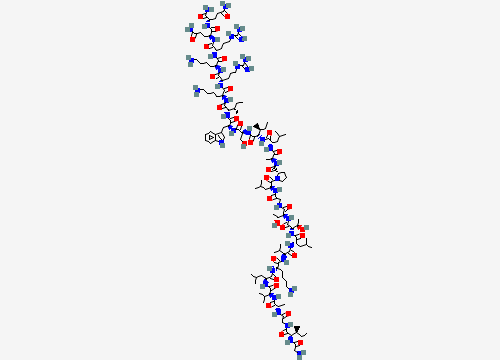
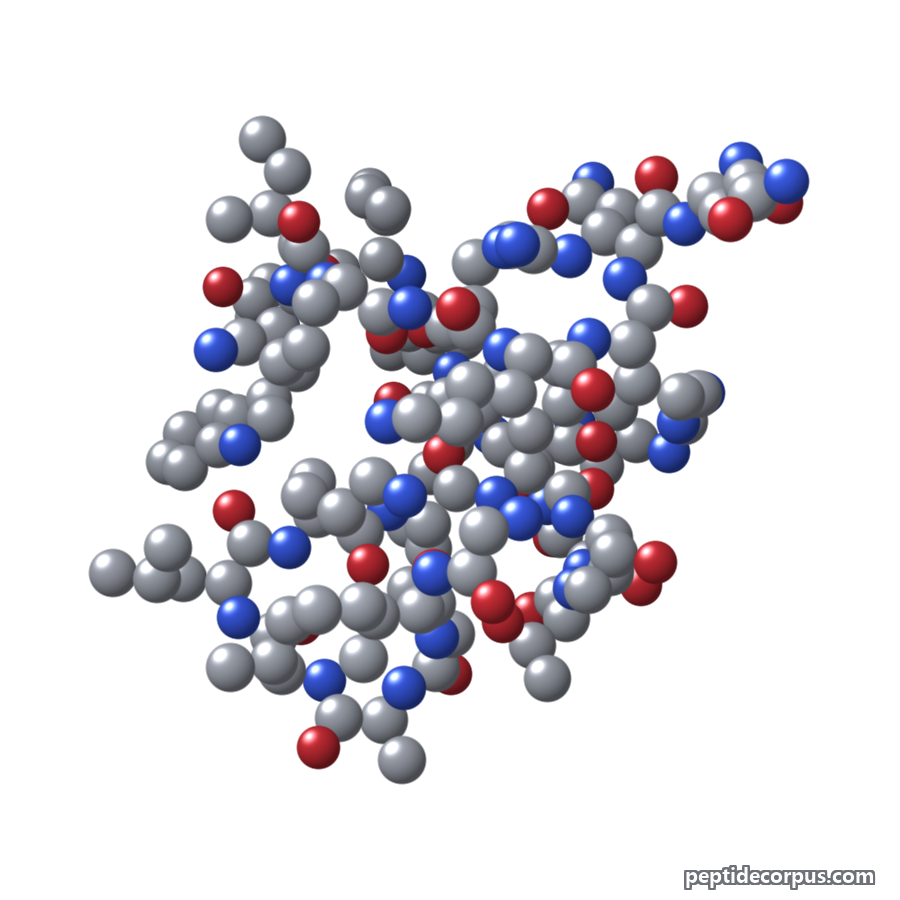
Drawn by PubChem from CID 16133648, the identifier on this record.
- Molecular weight
- 2846.5
- Molecular formula
- C131H229N39O31
- CAS number
- 37231-28-0
- PubChem CID
- 16133648
- UniProt
- P01504
- InChI key
- VDXZNPDIRNWWCW-JFTDCZMZSA-N
- SMILES
- CC[C@H](C)[C@@H](C(=O)NCC(=O)N[C@@H](C)C(=O)N[C@@H](C(C)C)C(=O)N[C@@H](CC(C)C)C(=O)N[C@@H](CCCCN)C(=O)N[C@@H](C(C)C)C(=O)N[C@@H](CC(C)C)C(=O)N[C@@H]([C@@H](C)O)C(=O)N[C@@H]([C@@H](C)O)C(=O)NCC(=O)N[C@@H](CC(C)C)C(=O)N1CCC[C@H]1C(=O)N[C@@H](C)C(=O)N[C@@H](CC(C)C)C(=O)N[C@@H]([C@@H](C)CC)C(=O)N[C@@H](CO)C(=O)N[C@@H](CC2=CNC3=CC=CC=C32)C(=O)N[C@@H]([C@@H](C)CC)C(=O)N[C@@H](CCCCN)C(=O)N[C@@H](CCCNC(=N)N)C(=O)N[C@@H](CCCCN)C(=O)N[C@@H](CCCNC(=N)N)C(=O)N[C@@H](CCC(=O)N)C(=O)N[C@@H](CCC(=O)N)C(=O)N)NC(=O)CN
- InChI
- InChI=1S/C131H229N39O31/c1-23-71(16)102(163-97(176)60-135)122(194)146-62-98(177)148-74(19)109(181)164-100(69(12)13)124(196)160-88(55-65(4)5)116(188)155-84(41-30-33-51-134)115(187)165-101(70(14)15)125(197)161-90(57-67(8)9)118(190)168-106(77(22)173)128(200)169-105(76(21)172)123(195)147-63-99(178)150-92(58-68(10)11)129(201)170-54-36-44-94(170)121(193)149-75(20)108(180)158-89(56-66(6)7)117(189)166-104(73(18)25-3)127(199)162-93(64-171)120(192)159-91(59-78-61-145-80-38-27-26-37-79(78)80)119(191)167-103(72(17)24-2)126(198)157-83(40-29-32-50-133)111(183)154-85(42-34-52-143-130(139)140)112(184)152-82(39-28-31-49-132)110(182)153-86(43-35-53-144-131(141)142)113(185)156-87(46-48-96(137)175)114(186)151-81(107(138)179)45-47-95(136)174/h26-27,37-38,61,65-77,81-94,100-106,145,171-173H,23-25,28-36,39-60,62-64,132-135H2,1-22H3,(H2,136,174)(H2,137,175)(H2,138,179)(H,146,194)(H,147,195)(H,148,177)(H,149,193)(H,150,178)(H,151,186)(H,152,184)(H,153,182)(H,154,183)(H,155,188)(H,156,185)(H,157,198)(H,158,180)(H,159,192)(H,160,196)(H,161,197)(H,162,199)(H,163,176)(H,164,181)(H,165,187)(H,166,189)(H,167,191)(H,168,190)(H,169,200)(H4,139,140,143)(H4,141,142,144)/t71-,72-,73-,74-,75-,76+,77+,81-,82-,83-,84-,85-,86-,87-,88-,89-,90-,91-,92-,93-,94-,100-,101-,102-,103-,104-,105-,106-/m0/s1
Notes unverified prose
Phase I topical (soft tissue infections); no systemic human trials; severe hemolysis limits clinical translation; preclinical only; Phase I topical (IRCT20190924044863N1); systemic hemolysis limits use
Not on file 2
1 of the 8 fields we track hold nothing on this record, and each says why. 1 further absence is named below. A blank field is a bug; a named absence is a finding.
- amino-acid sequencenothing we hold supplies it
- half-lifenothing we hold supplies it
Each field links to every other record missing the same thing. The full ledger holds 765 gaps across 163 records.
Share this record