Tissue Repair & Regeneration
Hexapeptide-11
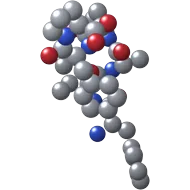
Hexapeptide-11 comes out of yeast fermentation, and what it aims at is more ambitious than most cosmetic ingredients: senescence, the worn-out state in which a skin cell stops dividing but does not die. In fibroblast and dermal papilla culture it reversibly turns down ATM and p53, two of the proteins that push cells into that state, and delays the markers of it. Nothing on file tests that idea in a person directly. The randomised trial carrying this record's tier studied a whole topical product used around cosmetic surgery, and the ingredient's own firmness figures come from a 25-person supplier study.
Last updated
Mechanism
Reversibly downregulates ATM and p53 expression in fibroblasts and dermal papilla cells, delaying senescence markers in vitro.
Reported effects
What sources associate with this compound. Reported categories, not outcomes we have graded — each would need its own citation and rung.
- Cellular senescence research
- Skin firmness research
- Skin elasticity context
Dosing on file unverified
2.8% solution, 2x/day (4 weeks)
Carried from a source that labels it unverified, and reproduced with that label attached. A record of what is reported, not a recommendation. No citation on this page establishes it.
Literature on file 5
-
computational
A framework for the safety evaluation of peptides in cosmetics. graded on: in-silico safety framework applied through six bioinformatic tools — read from the abstract — “abstract review”
-
human observational
Regeneration of the skin of oncology patients after radiation therapy using upcycled fish collagen. graded on: uncontrolled before/after skin hydration, TEWL and pH measurements in irradiated patients — read from the abstract — “abstract review”
-
in vitro
Designing topical hyaluronic acid technology-Size does matter…. graded on: an in-vitro system — read from the indexed abstract — “in vitro”
-
human RCT
A Multicenter, Randomized, Double-Blind, Split-Body Clinical Trial Evaluating the Efficacy and Outcomes of a Topical Product Pre and Post Aesthetic Surgical Body Procedures. graded on: a randomised trial — “Randomized, Double-Blind, Split-Body Clinical Trial”
-
in vitro
Advances in Pigmentation Management: A Multipronged Approach. graded on: an in-vitro system — read from the indexed abstract — “In vitro”
Identity
Skeletal formulathe canonical depiction
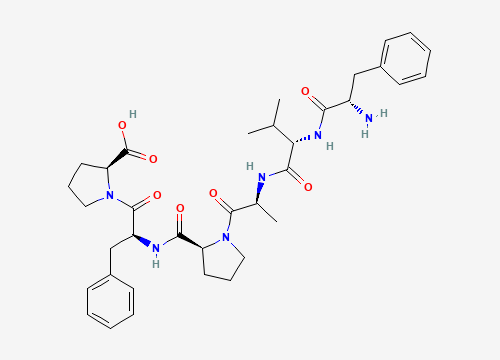
Drawn by PubChem from CID 24998056, the identifier on this record.
- Molecular weight
- 676.8
- Molecular formula
- C36H48N6O7
- CAS number
- 161258-30-6
- PubChem CID
- 24998056
- InChI key
- GFEYWOGCSROPRT-OBXVVNIGSA-N
- SMILES
- C[C@@H](C(=O)N1CCC[C@H]1C(=O)N[C@@H](CC2=CC=CC=C2)C(=O)N3CCC[C@H]3C(=O)O)NC(=O)[C@H](C(C)C)NC(=O)[C@H](CC4=CC=CC=C4)N
- InChI
- InChI=1S/C36H48N6O7/c1-22(2)30(40-31(43)26(37)20-24-12-6-4-7-13-24)33(45)38-23(3)34(46)41-18-10-16-28(41)32(44)39-27(21-25-14-8-5-9-15-25)35(47)42-19-11-17-29(42)36(48)49/h4-9,12-15,22-23,26-30H,10-11,16-21,37H2,1-3H3,(H,38,45)(H,39,44)(H,40,43)(H,48,49)/t23-,26-,27-,28-,29-,30-/m0/s1
Notes unverified prose
4-week in vivo study (n=25, 2.8%): improved skin elasticity and firmness around eyes and cheeks; proteostasis modulation; In vivo study (n=25, 2.8%, 4 weeks)
Not on file 2
1 of the 8 fields we track hold nothing on this record, and each says why. 1 further absence is named below. A blank field is a bug; a named absence is a finding.
- amino-acid sequencenothing we hold supplies it
- half-lifenothing we hold supplies it
Each field links to every other record missing the same thing. The full ledger holds 765 gaps across 163 records.
Share this record