Gastrointestinal Health
Gastrin
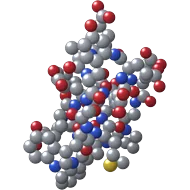
Gastrin's job is to tell the stomach to make acid, and clinically it is read rather than given. A raised level points to a gastrin-producing tumour; measured together with pepsinogen it is used to screen for the thinning of the stomach lining that precedes some cancers. A synthetic version, pentagastrin, is injected to provoke acid secretion during diagnostic testing. Where gastrin itself is being tried as a treatment, the settings are unexpected: a registered trial of whether it improves the outcome of islet transplantation, and a mouse study reporting that it suppresses remodelling of the heart after heart failure. The rest of the ten references on file are diagnostic, observational or case reports.
Last updated
Mechanism
Acts on CCK2 receptors, driving enterochromaffin-like cell histamine release and parietal cell acid secretion.
Reported effects
What sources associate with this compound. Reported categories, not outcomes we have graded — each would need its own citation and rung.
- Gastric acid research
- Mucosal growth research
- Neuroendocrine tumour context
Dosing on file unverified
Pentagastrin: 6 µg/kg SC (maximal gastric stimulation); IV: 0.6-6.0 µg/kg/hr dose-response
Carried from a source that labels it unverified, and reproduced with that label attached. A record of what is reported, not a recommendation. No citation on this page establishes it.
Literature on file 10
-
review or editorial
LUMINAL GASTRIN AND GASTRIN RELEASE (1977, cited 2x) graded on: indexed as "Letter" - secondary literature, not a study — “Letter”
-
human case series
Clinical Outcomes of Antrectomy for Patients With Multiple Type I Gastric Neuroendocrine Tumors: A Case Series. graded on: a case report or series — “Case Series”
-
human observational
Pharmacological safety and real-world efficacy of the potassium-competitive acid blocker fexuprazan in cardiovascular patients receiving antithrombotic therapy: a prospective cohort study (FEXGARD). graded on: an observational human design — “cohort”
-
animal in vivo
Gastrin ameliorates heart failure and suppresses myocardial remodeling via the JAK2/STAT3 and ERK1/2 pathways. graded on: an animal model — read from the indexed abstract — “rats”
- animal in vivo
-
human case series
A case of multiple type I endocrine neoplasia with gastrin-producing and glucagon-producing tumors successfully resected 18 years after insulinoma surgery. graded on: single published MEN1 case report with resection outcome — read from the abstract — “abstract review”
Not graded
4 citations whose study design could not be read from the title. Left ungraded rather than guessed at.
-
not graded
NCT01909245: Islet Transplantation Using a T-Cell Depleting Immunosuppression Induction Regimen graded on: NCT01909245 is active not recruiting and has posted no results - a registration, not a reported outcome — “NCT01909245”
-
not graded
NCT03746769: Improving Islet Transplantation Outcomes With Gastrin graded on: NCT03746769 is recruiting and has posted no results - a registration, not a reported outcome — “NCT03746769”
-
not graded
NCT02184910: Usefulness of Serum Pepsinogen and Gastrin as the Predictive Biomarker of Atrophic Gastritis, Intestinal Metaplasia and Gastric Cancer in Korea graded on: NCT02184910 is unknown and has posted no results - a registration, not a reported outcome — “NCT02184910”
-
not graded
NCT07060482: Diagnostic Performance of Combined Assays for Gastrin-17, Pepsinogen and Anti-helicobacter Pylori Antibodies for Diagnosing Gastric Atrophy. graded on: NCT07060482 is not yet recruiting and has posted no results - a registration, not a reported outcome — “NCT07060482”
Identity
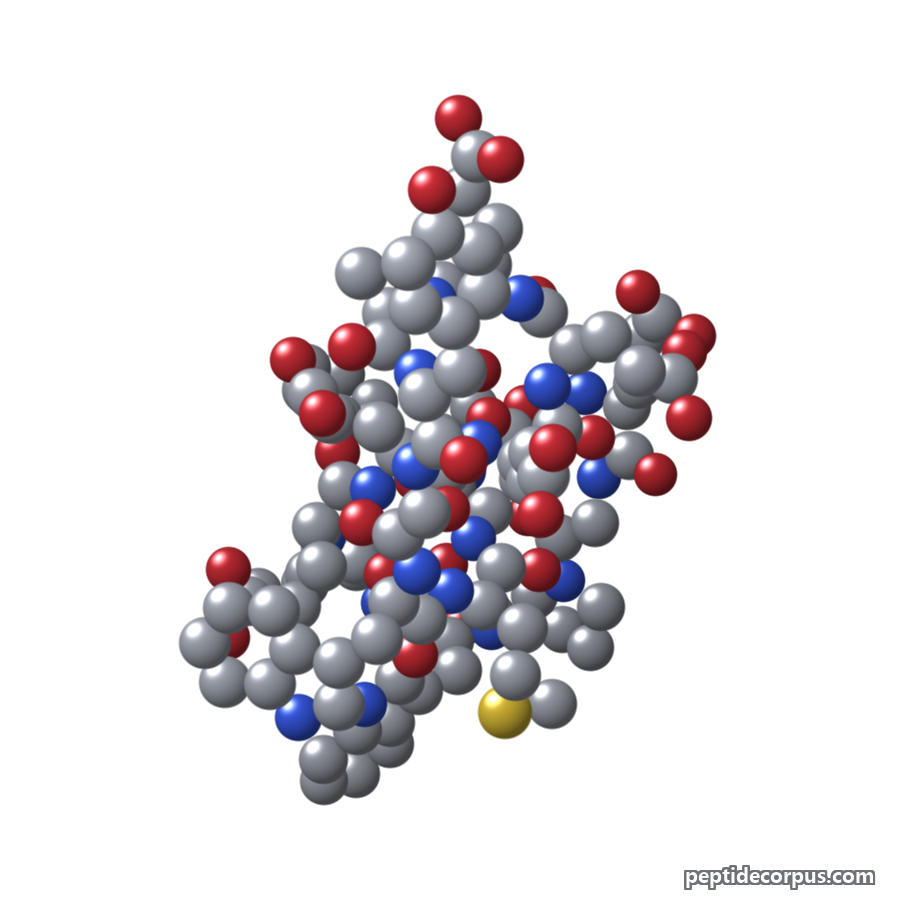
Skeletal formulathe canonical depiction
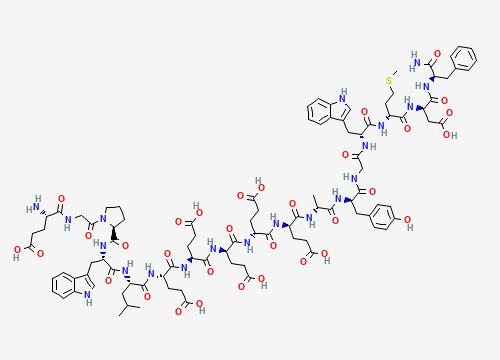
Drawn by PubChem from CID 44288444, the identifier on this record.
- Molecular weight
- 2116.2
- Molecular formula
- C97H126N20O32S
- CAS number
- 9002-76-0
- PubChem CID
- 44288444
- UniProt
- P01350 (precursor)
- InChI key
- AOXOCDRNSPFDPE-UKEONUMOSA-N
- Sequence
- EGPWLEEEEEAYGWMDF
- SMILES
- C[C@H](C(=O)N[C@H](CC1=CC=C(C=C1)O)C(=O)NCC(=O)N[C@H](CC2=CNC3=CC=CC=C32)C(=O)N[C@H](CCSC)C(=O)N[C@H](CC(=O)O)C(=O)N[C@H](CC4=CC=CC=C4)C(=O)N)NC(=O)[C@@H](CCC(=O)O)NC(=O)[C@@H](CCC(=O)O)NC(=O)[C@@H](CCC(=O)O)NC(=O)[C@H](CCC(=O)O)NC(=O)[C@H](CCC(=O)O)NC(=O)[C@H](CC(C)C)NC(=O)[C@H](CC5=CNC6=CC=CC=C65)NC(=O)[C@@H]7CCCN7C(=O)CNC(=O)[C@H](CCC(=O)O)N
- InChI
- InChI=1S/C97H126N20O32S/c1-49(2)39-68(114-95(147)71(43-54-46-101-60-18-11-9-16-57(54)60)116-97(149)73-19-12-37-117(73)75(120)48-103-85(137)58(98)24-30-76(121)122)93(145)110-65(29-35-81(131)132)91(143)109-64(28-34-80(129)130)90(142)108-63(27-33-79(127)128)89(141)107-62(26-32-78(125)126)88(140)106-61(25-31-77(123)124)87(139)104-50(3)84(136)113-69(41-52-20-22-55(118)23-21-52)86(138)102-47-74(119)105-70(42-53-45-100-59-17-10-8-15-56(53)59)94(146)111-66(36-38-150-4)92(144)115-72(44-82(133)134)96(148)112-67(83(99)135)40-51-13-6-5-7-14-51/h5-11,13-18,20-23,45-46,49-50,58,61-73,100-101,118H,12,19,24-44,47-48,98H2,1-4H3,(H2,99,135)(H,102,138)(H,103,137)(H,104,139)(H,105,119)(H,106,140)(H,107,141)(H,108,142)(H,109,143)(H,110,145)(H,111,146)(H,112,148)(H,113,136)(H,114,147)(H,115,144)(H,116,149)(H,121,122)(H,123,124)(H,125,126)(H,127,128)(H,129,130)(H,131,132)(H,133,134)/t50-,58+,61-,62-,63-,64+,65+,66-,67-,68+,69-,70-,71+,72-,73+/m1/s1
Notes unverified prose
Diagnostic use (gastric acid secretion testing); pentagastrin is synthetic analog; Pentagastrin diagnostic use
Not on file 1
All 8 tracked fields hold a value on this record. 1 further absence is named below. A blank field is a bug; a named absence is a finding.
- half-lifenothing we hold supplies it
Each field links to every other record missing the same thing. The full ledger holds 765 gaps across 163 records.
Share this record