Cardiovascular & General; Cardiovascular & Metabolic
Bradykinin
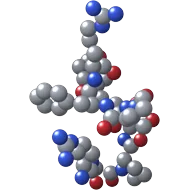
Bradykinin is what inflammation feels like, in molecular form. Released where tissue is injured, it widens blood vessels, loosens the junctions between the cells lining them so fluid leaks into the tissue, and fires pain nerves directly — the redness, the swelling and the ache, each traceable to one nine-amino-acid peptide. It also explains one of medicine's stranger side effects: angiotensin-converting enzyme (ACE) inhibitors slow the enzyme that clears bradykinin away, which is why a blood pressure tablet can swell a person's face and airway shut. Every medicine on file built around it, icatibant and ecallantide, is designed to block it rather than supply it, and in research it is infused into the forearm as a standard test of how well vessels dilate.
Last updated
Mechanism
Activates the B2 receptor on endothelium and nociceptors, raising nitric oxide and prostaglandins and loosening endothelial junctions.
Reported effects
What sources associate with this compound. Reported categories, not outcomes we have graded — each would need its own citation and rung.
- Vasodilation research
- Vascular permeability research
- Inflammatory pain context
Dosing on file unverified
IV bolus: ~0.1 µg/kg threshold; IV infusion: 0.125-1.25 µg/kg/min; 10-100 pmol/min; IV bolus: 0.001-7.5 µg/kg; Bolus: 60-600 pmol; Infusion: 30-2500 pmol/min
Carried from a source that labels it unverified, and reproduced with that label attached. A record of what is reported, not a recommendation. No citation on this page establishes it.
Literature on file 10
-
human observational
Icatibant for acute hereditary angioedema attacks in pediatric patients: A systematized review. graded on: a synthesis of human studies — the indexed publication type — “Systematic Review”
-
review or editorial
Therapeutic Targeting of the Bradykinin B2 Receptor in Immunological and Vascular Diseases: Insights from Kinin Biology to Clinical Outcomes. graded on: indexed as "Review" - secondary literature, not a study — “Review”
-
in vitro
G protein signaling capabilities at the bradykinin 2 receptor. graded on: an in-vitro system — read from the indexed abstract — “in vitro”
-
animal in vivo
Expression of PGE2, Histamine, Bradykinin, NaV-1.7, NaV-1.8, NaV-1.9 in Nerve Cells of Normal and Inflamed Dental Pulp Tissue Following Pulp Extirpation. graded on: an animal model — read from the indexed abstract — “rats”
-
human case series
Pediatric Non-Hereditary, Non-Allergic, Bradykinin-Mediated Angioedema in a Postoperative Intensive Care Patient: A Case Report. graded on: a case report or series — “Case Report”
-
human observational
NCT00685945: Renin-Angiotensin Aldosterone System and Fibrinolysis(RAAS) Interaction in Humans- Specific Aim 3 graded on: a registered clinical study — “clinicaltrials.gov”
-
human observational
NCT01413542: Pharmacogenetics of Ace Inhibitor-Associated Angioedema:Aim 1 graded on: a registered clinical study — “clinicaltrials.gov”
-
human observational
NCT02189122: Comparative Effects of Rapid-Release Aspirin and NHP-544C on Basal and Bradykinin Stimulated Prostacyclin Production graded on: a registered clinical study — “clinicaltrials.gov”
-
human observational
NCT03738878: Mechanism(s) Underlying Hypotensive Response to ARB/NEP Inhibition - Aim 1 graded on: a registered clinical study — “clinicaltrials.gov”
Not graded
1 citation whose study design could not be read from the title. Left ungraded rather than guessed at.
-
not graded
NCT01036659: Evaluation of Ecallantide for Acute Treatment of Angiotensin Converting Enzyme Inhibitor Induced Angioedema graded on: NCT01036659 is unknown and has posted no results - a registration, not a reported outcome — “NCT01036659”
Identity
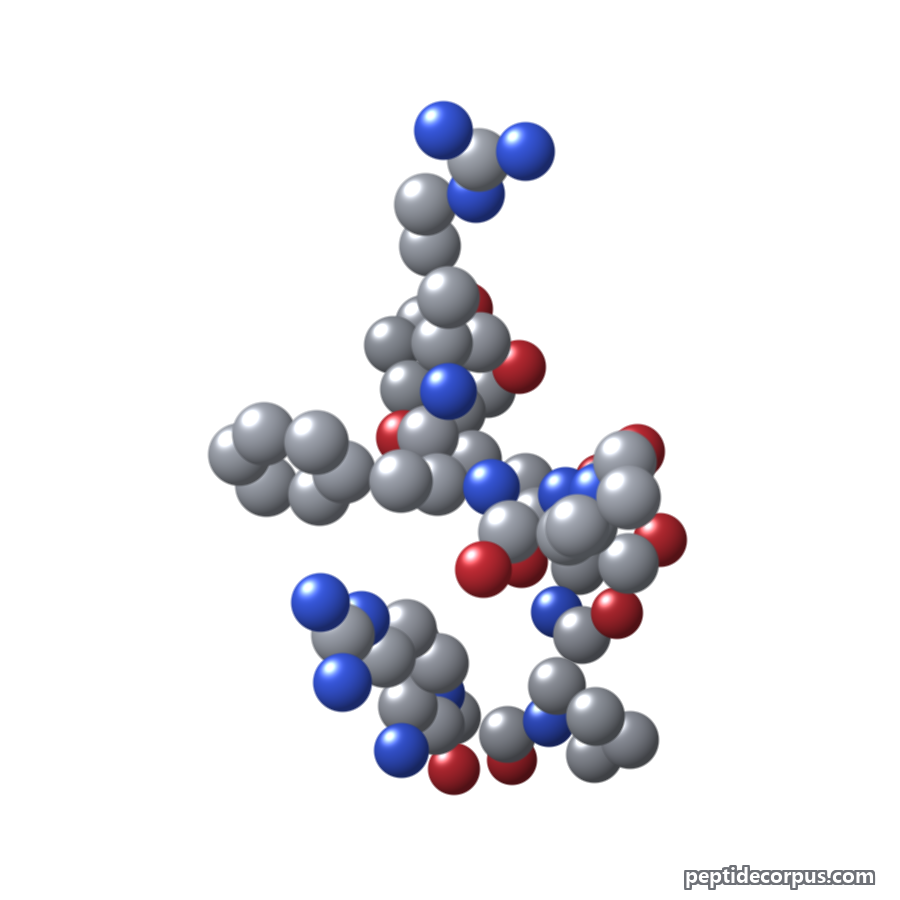
Skeletal formulathe canonical depiction
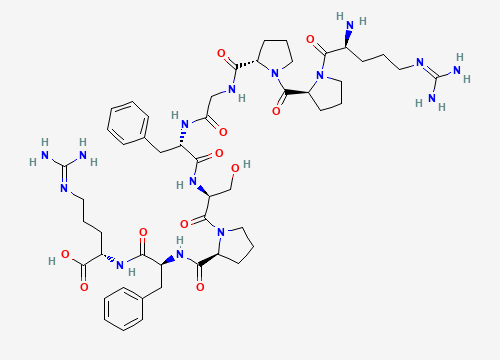
Drawn by PubChem from CID 439201, the identifier on this record.
- Molecular weight
- 1060.2
- Molecular formula
- C50H73N15O11
- CAS number
- 58-82-2
- PubChem CID
- 439201 (Bradykinin)
- UniProt
- P01042 (precursor)
- InChI key
- QXZGBUJJYSLZLT-FDISYFBBSA-N
- SMILES
- C1C[C@H](N(C1)C(=O)[C@@H]2CCCN2C(=O)[C@H](CCCN=C(N)N)N)C(=O)NCC(=O)N[C@@H](CC3=CC=CC=C3)C(=O)N[C@@H](CO)C(=O)N4CCC[C@H]4C(=O)N[C@@H](CC5=CC=CC=C5)C(=O)N[C@@H](CCCN=C(N)N)C(=O)O
- InChI
- InChI=1S/C50H73N15O11/c51-32(16-7-21-56-49(52)53)45(72)65-25-11-20-39(65)47(74)64-24-9-18-37(64)43(70)58-28-40(67)59-34(26-30-12-3-1-4-13-30)41(68)62-36(29-66)46(73)63-23-10-19-38(63)44(71)61-35(27-31-14-5-2-6-15-31)42(69)60-33(48(75)76)17-8-22-57-50(54)55/h1-6,12-15,32-39,66H,7-11,16-29,51H2,(H,58,70)(H,59,67)(H,60,69)(H,61,71)(H,62,68)(H,75,76)(H4,52,53,56)(H4,54,55,57)/t32-,33-,34-,35-,36-,37-,38-,39-/m0/s1
Also called
- Bradykinin (Cardiovascular)
Notes unverified prose
Human studies; dose-dependent vasodilation; Human IV/IA studies
Not on file 2
1 of the 8 fields we track hold nothing on this record, and each says why. 1 further absence is named below. A blank field is a bug; a named absence is a finding.
- amino-acid sequencenothing we hold supplies it
- half-lifenothing we hold supplies it
Each field links to every other record missing the same thing. The full ledger holds 765 gaps across 163 records.
Share this record