Yuviwel (Navepegritide): The Peptide Therapy That's Rewriting What's Possible in Dwarfism
On 27 February 2026 the U.S. Food and Drug Administration approved Yuviwel (navepegritide), a once-weekly injection for children with achondroplasia. It delivers a signal the human body already makes and destroys within minutes, and makes it last seven days. That is a problem peptide chemistry has been circling for decades, and this is what solving it looks like.
Last updated

What Yuviwel Is
Navepegritide, sold as Yuviwel, is a once-weekly injection for children with achondroplasia - the most common form of dwarfism, and the most common of all the skeletal dysplasias. It supplies a peptide the body already uses to regulate bone growth, rebuilt to stay in circulation for a week rather than for a couple of minutes.
It is a prodrug, and the design is elegant. What goes in is inactive. Over the days that follow it releases C-type natriuretic peptide steadily, continuously, at a rate set by chemistry rather than by biology. That is the answer to the problem that kept this molecule out of the clinic for decades: CNP is powerful, it is exactly the right signal, and in its natural form the bloodstream clears it faster than a nurse can put the needle away.
The label's indication is worth reading closely, because it is more precise than most of the coverage was. Yuviwel is indicated to increase linear growth in patients 2 years and older with achondroplasia and open epiphyses. Approved 27 February 2026, and on the market since April.
What the label says it is
A C-type natriuretic peptide prodrug, given to increase linear growth.
- Drug name: navepegritide. Brand name: Yuviwel
- One subcutaneous injection, once weekly
- Approved 27 February 2026; available in the United States since April 2026
- Made by Ascendis Pharma, on its TransCon carrier technology
Who it is for
Children whose growth plates are still open, which is what makes further growth possible at all.
- Aged 2 years and older
- Achondroplasia, with open epiphyses
- Granted under the FDA's Accelerated Approval pathway
- Not recommended in moderate or severe kidney impairment
How It Works
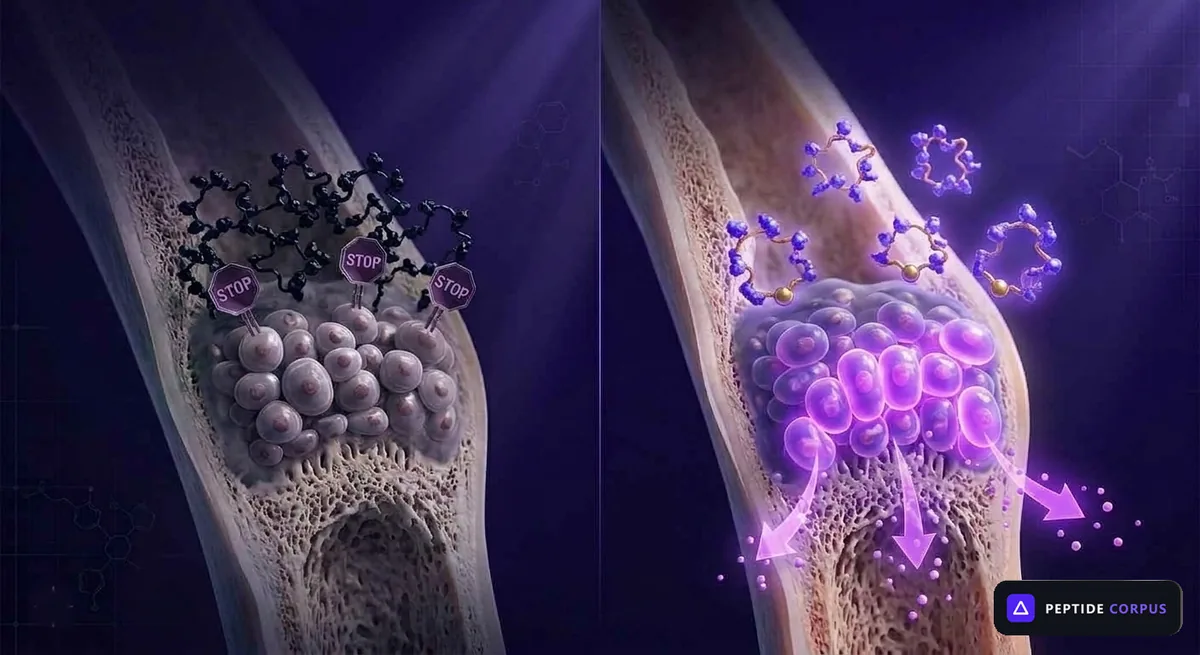
Achondroplasia comes down to a single change in a single gene, FGFR3. The receptor it codes for is stuck partly switched on, and what that receptor does when it is switched on is tell cartilage cells in the growth plate to stop dividing. Bone lengthens by laying down cartilage at the growth plate and turning it into bone, so a receptor that will not switch off is a brake held down for the whole of childhood. The label calls it a gain-of-function variant. It is a foot on a pedal that should be lifting.
Here is the part that makes this drug possible, and it is genuinely beautiful. The body already builds the counterweight. C-type natriuretic peptide binds a different receptor entirely - NPR-B - on the very same cells, and the signal it sends travels down through cGMP and protein kinase G to shut down the cascade FGFR3 is driving. The label's own phrase is that CNP acts by antagonising the overactive FGFR3 signalling. These two are not a drug and a target. They are the two arms of the system that sets how fast a child grows, and achondroplasia is one of them shouting over the other.
So the therapeutic idea was never in doubt. Turn the volume back up on the arm that is losing. The peptide released from navepegritide has, in the label's words, the same receptor binding affinity and activity as the CNP the body makes for itself - nothing about the molecule arriving at the receptor is invented. What is invented is that it is still arriving six days after the injection.
What It Fixes, and What It Leaves Alone
One line in the coverage is worth correcting, and correcting it makes the achievement larger rather than smaller. This is not a genetic fix. Navepegritide does not repair FGFR3, edit it, or silence it - it binds a different receptor and wins the argument downstream, for as long as it is being given. The label writes the boundary in plainly: discontinue on confirmation of no further growth potential, indicated by closure of the epiphyses.
That is the honest description and it is also the more interesting one. Correcting a gene in every cartilage cell of a growing skeleton is a problem nobody has solved. What Ascendis did instead was find the lever the body already has, and hold it down for a week at a time with one injection. That is not a lesser feat. It is a demonstration that you do not always have to rewrite the code - sometimes you can out-argue it, in the body's own vocabulary, and the argument is over before the child is old enough to remember it starting.
-
The body's own molecule
What reaches the receptor is CNP with the same binding affinity and activity as the kind the body makes itself. The engineering is all in the carrier.
-
The window is the growth plate
The label directs discontinuation once the epiphyses close. This is a drug for childhood, which is exactly when achondroplasia is decided.
-
The endpoint was velocity
The trial measured how fast children grew over a year, and that is what the approval rests on. Final adult height is what the confirmatory study is now running to show.
What the Trial Showed
ApproaCH was a randomised, double-blind, placebo-controlled phase 2b trial. It analysed 84 children with genetically confirmed achondroplasia, aged 2 to 11, randomised two to one - 57 to navepegritide, 27 to placebo - and followed for 52 weeks. The primary endpoint was annualised growth velocity: centimetres of height gained in a year.
Children on navepegritide grew at 5.9 cm a year against 4.4 on placebo. The treatment difference was 1.49 cm per year, 95% confidence interval 1.05 to 1.93, P below .001. That is a clean result on the endpoint the trial was built to test, and it separated early - the curves came apart within the first few months and stayed apart. Children who carried on into a second year held the faster rate rather than drifting back towards placebo.
The safety picture was about as good as a first year of exposure gets. No treatment-related serious adverse events. No deaths. Not one child stopped taking it because of a side effect.
Two things are worth holding onto while reading the headline number, and neither is a criticism. The effect is larger in older children - about 1.0 cm a year under five, about 1.8 at five and over. And growth velocity is a rate over one year, which the FDA's own summary states as treated children growing an average of 1.5 centimetres more across 52 weeks. What that compounds to over a childhood is precisely the question the confirmatory trial exists to answer.
The primary endpoint
Annualised growth velocity over 52 weeks, in centimetres of height gained per year.
- Navepegritide: 5.9 cm per year
- Placebo: 4.4 cm per year
- Difference: 1.49 cm per year (95% CI 1.05 to 1.93, P<.001)
- By age: about 1.0 cm/year under 5, about 1.8 cm/year at 5 and over
Also measured
Limb alignment and quality of life, as secondary and exploratory measures rather than primary ones.
- Tibial-femoral angle: -1.81 degrees (95% CI -3.16 to -0.47)
- Mechanical axis deviation: -2.78 mm (95% CI -4.71 to -0.86)
- Physical functioning improved in children under 5, with a confidence interval close to zero
- None of these figures appears in the FDA label
The Bigger Prize Is Still on the Table
Achondroplasia is not only a height, and this is where the story gets genuinely exciting rather than merely good. The same restricted bone growth narrows the opening at the base of the skull, crowds the spinal canal, shortens the middle third of the face and narrows the airway and the Eustachian tubes. Spinal stenosis, sleep apnoea, repeated middle ear infections, and in infancy the compression at the foramen magnum that is the condition's most serious risk - those are the medical stakes.
A drug that reaches the growth plate reaches the tissue all of that comes from. The mechanism is right there. Whether pushing on it early enough and hard enough translates into fewer apnoeas, fewer ear infections and fewer operations is the question worth the most, and it is the one nobody has answered yet - ApproaCH measured centimetres per year, and secondarily the shape of the legs, which is where the limb-alignment findings sit.
Those alignment numbers are the first hint in a controlled trial that the drug does more than lengthen, and they are worth being precise about for exactly that reason: they were secondary and exploratory rather than prespecified, and none of them appears in the FDA label. They are a lead, not a conclusion. If the follow-up work turns that lead into evidence, this stops being a growth drug and becomes a treatment for the condition, and that would be the larger headline by some distance.
How the Label Says to Take It
Yuviwel is dosed by body weight, and the figure that circulated in much of the coverage is not the figure on the label. 0.1 mg/kg per week was the dose studied in the trial. The prescribing information does not dose in mg/kg at all: it gives a table of fixed strengths against weight bands, and says only that of the dosages studied, 0.1 mg/kg per week is the one most similar to the approved schedule.
The distinction matters because a mg/kg figure invites arithmetic and the label does not want any. What follows is what the prescribing information states, reported here rather than recommended, with every dose set and adjusted by a physician as a child gains weight.
The label also covers the switch from daily CNP therapy, which is a real situation rather than a hypothetical: vosoritide, the other approved drug on this pathway, is a daily injection.
What the label states
Fixed strengths against weight bands, once weekly, under the skin.
- A weight-band table, from 0.88 mg at 8 to 9.9 kg up to 8.8 mg at 73.6 to 90 kg
- Two kits are required above 56 kg
- Supplied as a lyophilised powder in single-dose vials for reconstitution, in 1.3, 2.8 and 5.5 mg strengths
- Every component is single use
Boundaries on the label
Four instructions that are easy to miss and are the reader's business.
- Switching from daily CNP: start Yuviwel the day after the last daily dose
- Not recommended in moderate or severe kidney impairment (eGFR below 60)
- Discontinue once the growth plates have closed
- No contraindications are listed, and there is no boxed warning
Side Effects on the Label
A good deal of what appeared in early write-ups of this drug is not on the label, and the difference is worth knowing because it makes the safety profile look better rather than worse. Fever, colds, ear infections and upper respiratory infections were all recorded during the study at rates that look alarming in isolation. None of them qualified as a label adverse reaction: the rule is at least 5% of treated children and at least 2 percentage points above placebo, and those childhood illnesses happened at much the same rate in children receiving nothing, because the study population is toddlers.
What the label lists is four reactions, and the placebo column is what makes them readable. Vomiting and injection-site reactions, the two commonest, ran roughly five to seven percentage points above placebo. Hypertrichosis - extra hair growth - was reported in 3% against none, and the label pairs it with an instruction to rotate injection sites. There are no contraindications and no boxed warning.
One precaution deserves reading carefully rather than quickly, because its wording is unusual. The label carries a warning about transient decreases in blood pressure and attributes it to a once-daily CNP analogue - which is to say to vosoritide, not to navepegritide. It is a class warning inherited from a relative. The published trial reported no symptomatic hypotension at all, and children with significant cardiovascular disease were excluded from the studies. It is neither a finding to be alarmed by nor a line to skip: the signs it names are worth knowing, and they are a conversation with the prescribing physician rather than a reason to skip a dose.
Adverse reactions on the label
The reactions listed in the prescribing information, against placebo.
- Vomiting: 21% on navepegritide, 14% on placebo
- Injection-site reaction: 19% against 14%
- Pain in an extremity: 12% against 7%
- Nausea: 6% against none
- Hypertrichosis: 3% against none
The blood pressure precaution
A class warning carried over from the daily CNP analogue, not a navepegritide finding.
- The label attributes it to a once-daily CNP analogue
- The published trial reported no symptomatic hypotension
- Signs named: dizziness, fatigue, nausea
- Patients with significant cardiovascular disease were excluded from the trials
Why the Peptide Engineering Is the Story
Strip away the indication and what is left should interest anyone following peptide medicine, because it is the field's oldest obstacle falling over. CNP is a signalling peptide the human body has always made. It is also, in its natural form, almost useless as a drug: cleared within minutes, so holding a therapeutic level in a child's bloodstream would mean a continuous infusion for the length of their childhood. The molecule was never the problem. The pharmacokinetics were, and they have defeated an enormous number of good ideas.
TransCon is the answer, and it is simpler than the name. The active peptide is attached to a carrier through a linker built to come apart at a predictable rate under the conditions of the body. Nothing has to be metabolised to release it. No enzyme has to find it. The chemistry simply proceeds, at a rate you can design in advance. What is injected is inert, and what it becomes - slowly, evenly, across the following week - is the unmodified peptide the body already knows exactly what to do with.
That is why the weekly schedule is more than a convenience, though it is emphatically also a convenience: the distance between fifty-two injections a year and three hundred and sixty-five, given to a small child by a parent at the kitchen table, is not a footnote in anybody's life. It is that sustained release converts a peptide's greatest weakness into a solved problem without touching the peptide itself.
Be precise about which first this is, because the precise version is still remarkable. Vosoritide, approved in 2021, is also a CNP analogue peptide - it is simply dosed daily. Navepegritide is the first once-weekly CNP analogue, and the two have never been compared head to head. The advance is duration, and duration is the thing this whole class of medicine has been waiting on.
Now generalise it, because this is the part that reaches past one condition. The peptide engineering that gave us the metabolic drugs of the last decade was aimed at enormous markets. Achondroplasia affects roughly one in twenty-five thousand births. A platform that can take a natural human signalling peptide, give it a week-long duration, and carry it all the way through a regulatory approval is a platform that can now be pointed at conditions whose patient populations were previously too small to justify the chemistry. There are a great many of those, and every one of them is somebody's child.
-
Minutes to a week
CNP's natural half-life is a few minutes. Predictable linker cleavage is what turns that into a weekly injection without a pump or an infusion.
-
Released, not metabolised
No enzyme has to find the linker. It comes apart on a schedule set at the bench, which is what makes the release rate a design choice.
-
A platform, not a one-off
The same approach applies to any peptide whose problem is duration rather than potency, which is a very large share of them.
What Accelerated Approval Commits To
Yuviwel was approved under the FDA's Accelerated Approval programme, which lets a drug for a serious condition reach patients on the strength of a surrogate endpoint - a measurement thought likely to predict real benefit - before that benefit has been demonstrated outright. Here the surrogate is annualised growth velocity, and the label says so on its first page: continued approval may be contingent on verification of clinical benefit in confirmatory trials.
What the confirmatory study has to show is final adult height, and no data on it exists yet anywhere - the phrase does not appear in the label at all, and the longest follow-up reported is that the growth rate held through a second year. It takes the better part of a childhood to answer, and no deadline has been made public.
That is not a knock on the approval. It is the whole reason the pathway exists. Waiting for the definitive endpoint here would mean withholding a working therapy from a generation of children who would have closed their growth plates before the answer arrived - the one thing a drug for childhood cannot do is arrive late. The trade was made deliberately, in favour of the children who are two years old right now, and knowing which half of it has been delivered is simply the reader's business.
Whose Decision This Is
There is a conversation around this class of drug that a purely pharmacological write-up would miss. Many people with achondroplasia regard dwarfism as human variation rather than a disease awaiting correction, and that view is held by adults who have lived the condition. It is not a misunderstanding of the science, and any honest account of this approval has to carry it.
It sits alongside the medical facts above - the airway, the spine, the ears, the foramen magnum - which are why so many families have wanted a treatment for so long, and why the strongest case for this drug was never really about height at all.
Both meet at a specific, practical, entirely constructive request, made publicly when the ApproaCH results were published in November 2025. Michael Hughes, Chair of the Biotech Industry Liaison Committee at Little People of America, said that to help guide their healthcare decisions, families want information beyond changes in height, to understand how an intervention may affect the potential medical challenges of achondroplasia - and that including those endpoints in blinded, controlled studies, as ApproaCH began to, starts to fill that gap.
That is one committee chair speaking rather than a position statement from the organisation, and it is worth attributing carefully for that reason. It is also, read plainly, an invitation. The community with the most at stake is not asking for the research to stop. It is asking for it to measure the right things, and it named them first - which is the best possible starting point for whatever comes after this drug.
Glossary
The terms used above, defined once.
- Accelerated Approval
- An FDA pathway allowing earlier approval of a drug for a serious condition on the basis of a surrogate endpoint reasonably likely to predict clinical benefit, on condition that a confirmatory study follows.
- Achondroplasia
- The most common form of dwarfism, caused by a gain-of-function variant in FGFR3 that leaves the receptor partly switched on and slows growth at the growth plates.
- Annualised growth velocity (AGV)
- The rate of height gain in centimetres per year. The primary endpoint of the ApproaCH trial and the surrogate the accelerated approval rests on.
- ApproaCH
- The pivotal phase 2b randomised, double-blind, placebo-controlled trial of navepegritide in children with achondroplasia.
- C-type natriuretic peptide (CNP)
- A peptide the body produces that regulates bone growth by opposing FGFR3 signalling at the growth plate. Cleared from the blood within minutes in its natural form.
- Epiphyses (growth plates)
- Zones of cartilage near the ends of long bones where lengthening happens during childhood. Once they fuse, height no longer increases.
- FGFR3
- Fibroblast growth factor receptor 3. A variant leaving it overactive acts as a brake on bone growth, which is the cause of achondroplasia.
- Foramen magnum
- The opening at the base of the skull through which the spinal cord passes. Narrowing of it is the most serious early complication of achondroplasia.
- Gain-of-function variant
- A genetic change that makes a protein more active rather than less. In achondroplasia the receptor signals when it should be quiet.
- Mechanical axis deviation
- How far the weight-bearing line through the leg departs from the centre of the knee. A standard measure of bowing.
- NPR-B
- Natriuretic peptide receptor B, the receptor CNP binds. It is not FGFR3; the two pathways meet further downstream.
- Prodrug
- A compound given in an inactive form that becomes the active drug inside the body. Navepegritide releases CNP after injection.
- Surrogate endpoint
- A measurement used in place of the outcome actually cared about, on the reasoning that it predicts it. Growth velocity stands in for adult height here.
- Tibial-femoral angle
- The angle between the thigh bone and the shin bone, used to quantify how bowed or knock-kneed a leg is.
- TransCon
- The carrier and linker technology behind Yuviwel, which releases an unmodified peptide slowly by predictable chemical cleavage rather than by metabolism.
- Vosoritide
- The other approved CNP analogue for achondroplasia, given as a daily injection and approved in 2021.
Sources and evidence
Sources and evidence
8 sourcesHighlights of Prescribing Information - YUVIWEL (navepegritide). U.S. Food and Drug Administration, 2026Label
How this source supports the article
The indication and its wording, the weight-band dosing table, the vial strengths, the transition from daily CNP therapy, the renal restriction, the instruction to discontinue at epiphyseal closure, the adverse reactions with their placebo rates, the absence of contraindications and of a boxed warning, and the mechanism as the agency describes it.
Limitations
A label records what was approved and what was observed in the trials submitted. It carries no comparison against other drugs, and none of the trial's limb-alignment or quality-of-life findings appears in it.
Savarirayan R, McDonnell C, Bacino CA, et al. Navepegritide in Children With Achondroplasia. JAMA Pediatrics 2026;180(1):18-25Human RCT
How this source supports the article
The trial design as phase 2b, the 2:1 randomisation of 84 analysed children aged 2 to 11, the growth velocity difference of 1.49 cm/year with its confidence interval, the tibial-femoral angle and mechanical axis deviation figures, the quality-of-life result in children under 5, and that no symptomatic hypotension was reported.
Limitations
Three errata have been published against this paper (180(1):118; 180(3):348; 180(5):587). Six authors are employees of, or hold stock in, the manufacturer. The limb-alignment and quality-of-life measures were secondary and exploratory, and the trial enrolled treatment-naive children only.
FDA Approves Drug for Pediatric Patients with Most Common Form of Dwarfism. U.S. Food and Drug AdministrationRegulatory
How this source supports the article
The approval, the approved population, that it was granted under Accelerated Approval, that the confirmatory study must show final adult height, and the agency's own phrasing of the year-one result as roughly 1.5 cm more growth over 52 weeks.
Limitations
An announcement states what was approved and for whom. It is not the trial report and carries no efficacy or safety tables. The page's own date stamp is a currency date rather than the approval date.
A Study of Navepegritide (TransCon CNP) in Children with Achondroplasia (ApproaCH). ClinicalTrials.gov, NCT05598320Trial registration
How this source supports the article
The trial design, the enrolment, the age range, the randomisation against placebo, and that annualised growth velocity was the prespecified primary endpoint.
Limitations
A registration describes what was planned and measured. It is not the results paper and carries no interpretation.
FDA Approves Once-Weekly YUVIWEL (navepegritide) for Children with Achondroplasia Aged 2 Years and Older. Ascendis Pharma, 27 February 2026Manufacturer
How this source supports the article
The approval date of 27 February 2026, and the manufacturer's own description of the product as the first and only once-weekly therapy in this class.
Limitations
A manufacturer's release about its own product. Every claim in it should be read against the label, which is the document the agency approved.
Ascendis Receives Orphan Drug Exclusivity and Launches YUVIWEL (navepegritide) in the United States. Ascendis Pharma, 6 April 2026Manufacturer
How this source supports the article
That the drug became commercially available in the United States in April 2026, and that it was granted seven years of orphan drug exclusivity.
Limitations
Availability and exclusivity are commercial facts. They say nothing about how well the drug works.
Results of Pivotal ApproaCH Trial of TransCon CNP (Navepegritide) Published in JAMA Pediatrics. Ascendis Pharma, 17 November 2025Manufacturer
How this source supports the article
The quotation from Michael Hughes, Chair of the Biotech Industry Liaison Committee at Little People of America, its date, and the subject it was given about.
Limitations
The quotation was carried in the manufacturer's own release about its own results, and is one committee chair's remark rather than a position statement from Little People of America.
Highlights of Prescribing Information - VOXZOGO (vosoritide). U.S. Food and Drug Administration, 2021Label
How this source supports the article
That vosoritide is itself a CNP analogue peptide, approved in 2021 and dosed once daily by subcutaneous injection - which is what makes navepegritide the first once-weekly drug in this class rather than the first peptide.
Limitations
A separate drug's label. It supports the comparison of dosing schedules and nothing about relative efficacy, on which no head-to-head trial exists.